TL;DR:
- Carbon fiber yellowing results from UV damage to the resin coating, not the fiber itself.
- Premium UV-resistant resins with stabilizers extend clarity beyond a decade, unlike budget options.
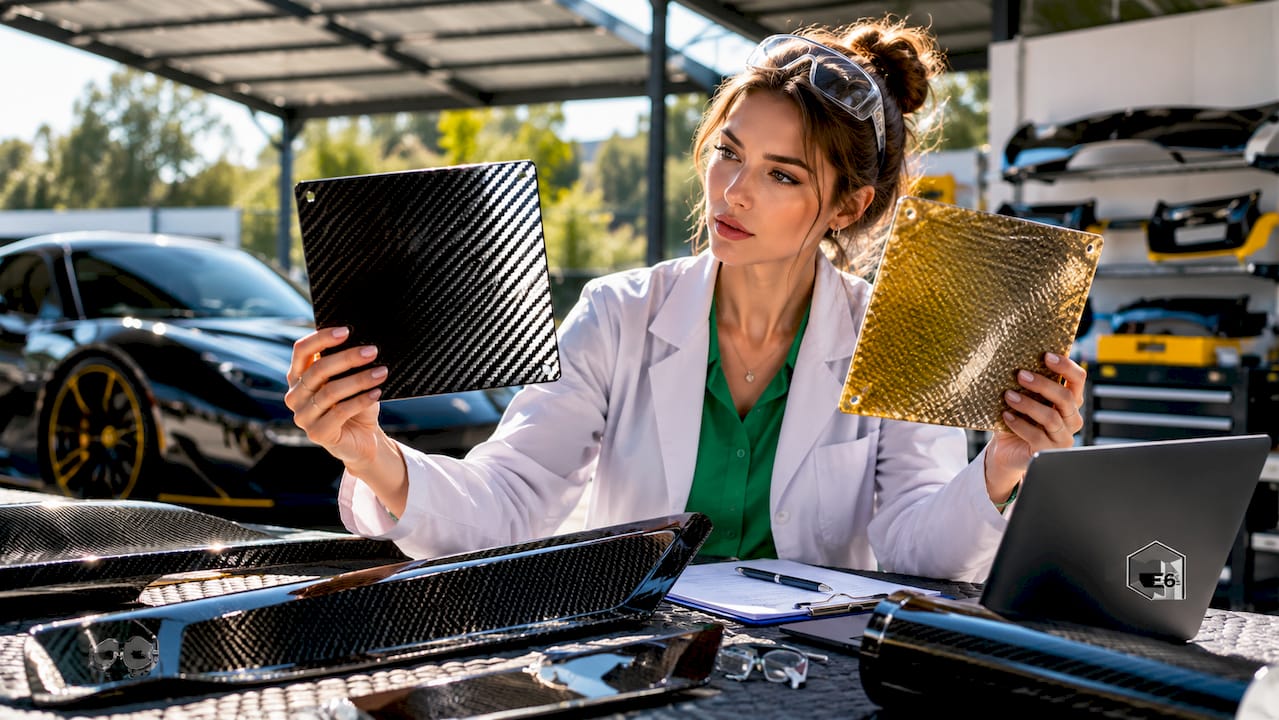
Carbon fiber yellowing is defined as UV-induced degradation of the clear resin coating, not the carbon fiber itself. The carbon weave underneath stays structurally intact. What fails is the epoxy or clear coat sitting on top of it. Cheap resins lack the UV stabilizers needed to survive sustained sun exposure, and they begin breaking down within months. Premium UV-resistant resins, by contrast, use hindered amine light stabilizers (HALS) and triazine UV absorbers to hold their clarity for years. For owners of Mercedes-AMG, Lexus LC500, or McLaren platforms, understanding this distinction is the difference between carbon that ages gracefully and carbon that looks neglected by year two.
Why UV-resistant resins determine if cheap carbon fiber turns yellow
Carbon fiber yellowing is caused by a photochemical process called photodegradation. UV photons carry enough energy to break the polymer chains inside epoxy resins and clear coats. When those chains fracture, they form new molecular structures called chromophores. Chromophores absorb blue light from the visible spectrum, which shifts the perceived color of the coating toward yellow.
The fiber itself is chemically inert under UV exposure. The resin is not. This is the single most misunderstood fact in the carbon fiber aftermarket. Owners blame the part when the real failure is the finishing system applied over it.
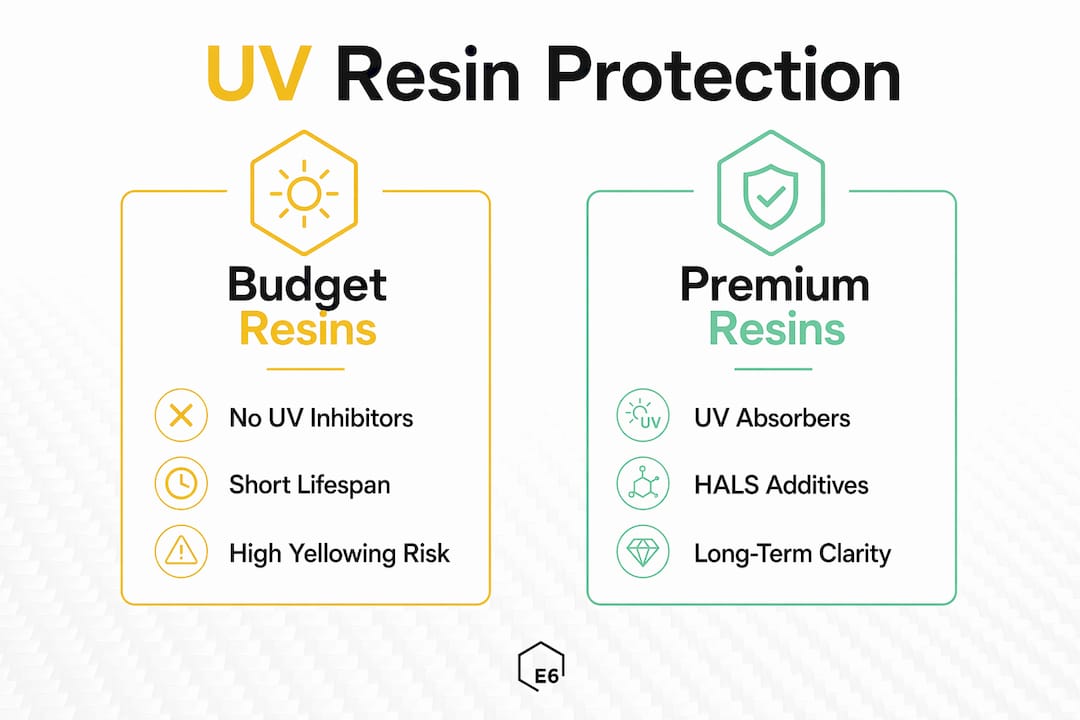
Budget resin systems accelerate this process because they skip the UV inhibitor package. Cheap clear coats yellow within 12–18 months under regular sun exposure. Premium UV-resistant systems extend that window to 7–10 years or longer. That gap is not marketing language. It reflects a real difference in resin chemistry.
Heat compounds the problem. Engine bay carbon parts yellow faster than exterior body panels because thermal stress accelerates the same photochemical reactions UV triggers. A budget wet-layup hood scoop on a Mercedes-AMG C63 faces both UV radiation from above and heat cycling from below. That combination destroys cheap clear coats fast.
- Wet-layup epoxies use generic resin systems with minimal UV protection. They are the most common source of early yellowing in budget aftermarket parts.
- Chromophore formation begins immediately upon UV exposure. The yellowing you see after six months started on day one.
- Heat + UV combined worsen clear coat photochemistry faster than either factor alone.
- Contaminants like road chemicals and industrial fallout create surface micro-damage that accelerates UV penetration.
Pro Tip: If a carbon fiber part is priced significantly below market rate, assume the resin system is the first cost-cutting target. The weave may look identical, but the finishing chemistry will not be.
How do premium UV-resistant resins protect carbon fiber long-term?
High-grade prepreg resins used in autoclave-cured carbon fiber parts are formulated with tighter resin-to-fiber ratios and controlled cure cycles. That process produces a denser, more chemically stable matrix than wet-layup methods. The result is a base that resists UV penetration before the clear coat even comes into play.
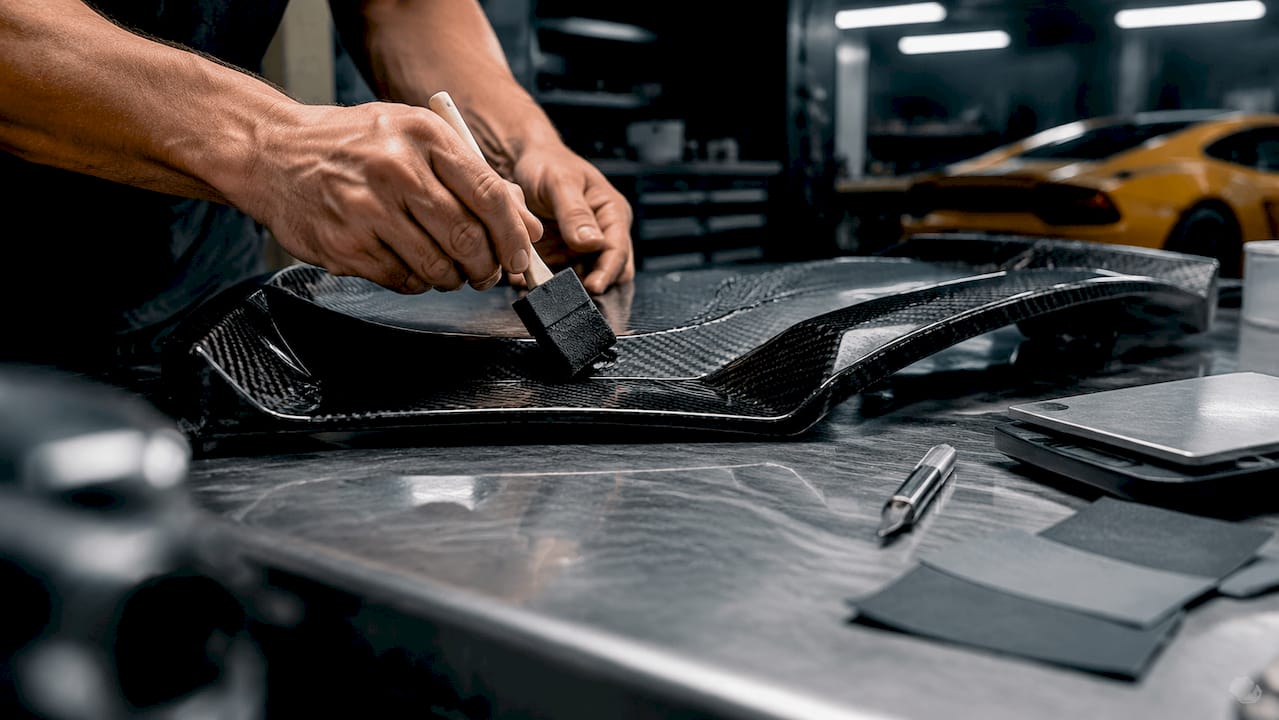
The clear coat layer is where UV protection is most concentrated. HALS and UV absorbers in clear coats chemically stabilize automotive finishes against yellowing. Triazine-based UV absorbers intercept UV photons before they reach the polymer chains. HALS then interrupt the radical chain reactions that would otherwise cause chromophore formation. Used together, they outperform either additive alone.
Combining UV absorbers and HALS delivers more durable anti-yellowing performance than either chemistry in isolation. This is why marine-grade clear coats, originally developed for boat hulls exposed to constant sun and saltwater, translate well to automotive carbon fiber. E6 Carbon applies high-temperature, marine-grade UV-resistant clear coats specifically because they were engineered for sustained environmental punishment.
| Finish type | UV inhibitor package | Expected clarity lifespan |
|---|---|---|
| Budget wet-layup epoxy | None or minimal | 3–18 months |
| Standard automotive clear coat | Basic UV absorber | 2–4 years |
| Premium clear coat with HALS | UV absorber + HALS | 7–10+ years |
| Marine-grade UV-resistant clear coat | Full-spectrum UV + HALS | 10+ years |
Pro Tip: Ask your carbon fiber supplier specifically whether their clear coat contains both a UV absorber and a HALS additive. If they cannot answer that question, the finish is likely budget-grade.
Wet-layup vs. prepreg vs. forged carbon: which resists yellowing best?
The manufacturing method determines the resin system, and the resin system determines how fast the part yellows. This is not a minor variable. It is the primary driver of long-term appearance.
Wet-layup carbon uses dry fiber fabric saturated manually with liquid epoxy. The resin content is inconsistent, and the cure happens at room temperature or low heat. Budget manufacturers use generic epoxy with no UV stabilizer package. Budget gel-coated finishes can turn yellow within 3–6 months of daily sun exposure. That timeline is not an edge case on a Lamborghini Huracán parked in a Florida driveway.
Prepreg carbon fiber uses resin-impregnated fabric cured under heat and pressure in an autoclave. The resin content is precisely controlled, and the cure chemistry is more stable. UV resistance still depends on the clear coat applied afterward, but the base laminate is far more consistent. The Lexus LC500 dry vs. wet guide from E6 Carbon covers this distinction in detail for owners choosing between manufacturing methods.
Forged carbon fiber uses chopped carbon fiber mixed with resin and compression-molded under high pressure. The resin matrix is dense and void-free. UV resistance characteristics match high-quality prepreg when paired with a proper clear coat system.
- Wet-layup without UV stabilizers: yellows within 3–18 months.
- Prepreg with standard clear coat: holds clarity for 2–4 years before visible degradation.
- Prepreg or forged with marine-grade UV clear coat: maintains clarity for 10 or more years with proper maintenance.
- Paint protection film (PPF) over any finish: adds a sacrificial UV barrier that extends the underlying clear coat’s life significantly.
Yellowing is cumulative and often irreversible, which means prevention is the only real strategy. Polishing rarely restores original clarity once degradation penetrates below the surface layer.
How can luxury car owners prevent carbon fiber from yellowing?
Prevention requires a layered approach. No single product eliminates UV risk permanently, but the right combination extends clarity for years beyond what an untreated part achieves.
- Apply a ceramic coating. Ceramic coatings create a hard, UV-blocking layer over the clear coat. They bond chemically to the surface and resist washing, UV radiation, and chemical contamination better than wax alone.
- Install UV-blocking PPF. Paint protection film acts as a sacrificial barrier. It absorbs UV before it reaches the resin. High-quality PPF with UV inhibitors is the most effective single layer of protection available for exterior carbon parts.
- Use UV-protective wax on a schedule. Routine waxing creates UV protection layers that degrade over time and require reapplication. Treat it as a maintenance interval, not a one-time fix.
- Park in shade or use a breathable car cover. Direct sun exposure is the primary driver of resin degradation. Reducing exposure time reduces cumulative UV dose on the clear coat.
- Avoid harsh chemicals and abrasive cleaners. These strip the clear coat’s UV inhibitor layer and accelerate penetration. Use pH-neutral automotive soaps and soft microfiber cloths only.
Pro Tip: For Mercedes-AMG GT or McLaren 720S owners with exposed engine bay carbon, apply a dedicated high-temperature ceramic coating rated for thermal cycling. Standard ceramic products are not formulated for the heat range those environments produce.
Key takeaways
UV-resistant resins are the primary factor separating carbon fiber that stays clear for a decade from parts that yellow within a season.
| Point | Details |
|---|---|
| Resin fails, not fiber | UV degrades the clear resin coating; the carbon weave itself is chemically stable under UV exposure. |
| Cheap resins yellow fast | Budget wet-layup epoxies without UV stabilizers can yellow within 3–18 months of regular sun exposure. |
| HALS + UV absorbers work together | Combining triazine UV absorbers and HALS delivers significantly longer clarity than either additive alone. |
| Yellowing is irreversible | Degradation below the surface cannot be polished out; prevention is the only effective strategy. |
| Maintenance must be cyclical | Ceramic coatings, PPF, and UV waxes all degrade over time and require scheduled reapplication. |
The uncomfortable truth about budget carbon fiber
We have seen this pattern repeatedly at E6 Carbon. An owner buys a wet-layup carbon hood or splitter from a budget supplier, installs it on a Mercedes-AMG E63 or a Lexus LC500, and it looks sharp for the first season. By month 14, the clear coat has a yellow cast. By month 24, it looks like aged plastic. The owner then spends more removing and replacing the part than they saved buying cheap in the first place.
The resin system is always the first line item cut in budget manufacturing. It is invisible at purchase and only reveals itself after UV exposure accumulates. That is a deliberate asymmetry that budget suppliers rely on.
At E6 Carbon, every autoclave-cured part leaves our facility with a marine-grade, high-temperature UV-resistant clear coat. That is not a marketing claim. It is a specification choice made because our customers drive McLarens and Lamborghinis in climates that punish inferior finishes. We also recommend pairing our parts with a professional ceramic coating application for owners in high-UV regions. The carbon fiber finishing workflow we follow is designed around long-term clarity, not short-term cost reduction.
The lesson is simple. Buy the part once. Buy it right.
— E6 Engineering
E6 Carbon’s UV-resistant carbon fiber components
E6 Carbon engineers every autoclave-cured carbon fiber component with marine-grade UV-resistant clear coats designed to hold structural integrity and clear gloss under sustained sun and heat exposure. The finishing system is not an afterthought. It is part of the engineering specification for every body kit, hood, splitter, and aero component we produce for platforms including Mercedes-AMG, Lexus LC500, McLaren, and Lamborghini.
Owners who want carbon that looks as sharp in year eight as it did on install day can explore the full range of E6 Carbon aero components and finishing specifications on our website. For Lexus LC500 owners specifically, the AeroTech Carbon Fiber Hood is built to the same UV-resistant standard and is a direct upgrade over wet-layup alternatives. Every component ships with the resin chemistry documentation to back the claim.
FAQ
What actually causes carbon fiber to turn yellow?
UV radiation breaks polymer chains in the clear resin coating, forming chromophores that absorb blue light and create a yellow tint. The carbon fiber itself does not yellow.
How long before cheap carbon fiber starts yellowing?
Budget gel-coated finishes can show visible yellowing within 3–6 months of daily sun exposure. Premium UV-resistant clear coats extend that window to 7–10 years or more.
Can yellowed carbon fiber be restored?
Yellowing that has penetrated below the surface layer cannot be polished out. Prevention with quality UV barriers is the only reliable strategy.
What UV protection additives actually work in clear coats?
Triazine UV absorbers combined with HALS provide the most durable anti-yellowing performance. Each additive targets a different stage of the photodegradation process.
How often should UV protection coatings be reapplied?
UV protection layers degrade under sun and heat and require cyclical reapplication. Ceramic coatings typically need refreshing every one to two years depending on climate and exposure level.