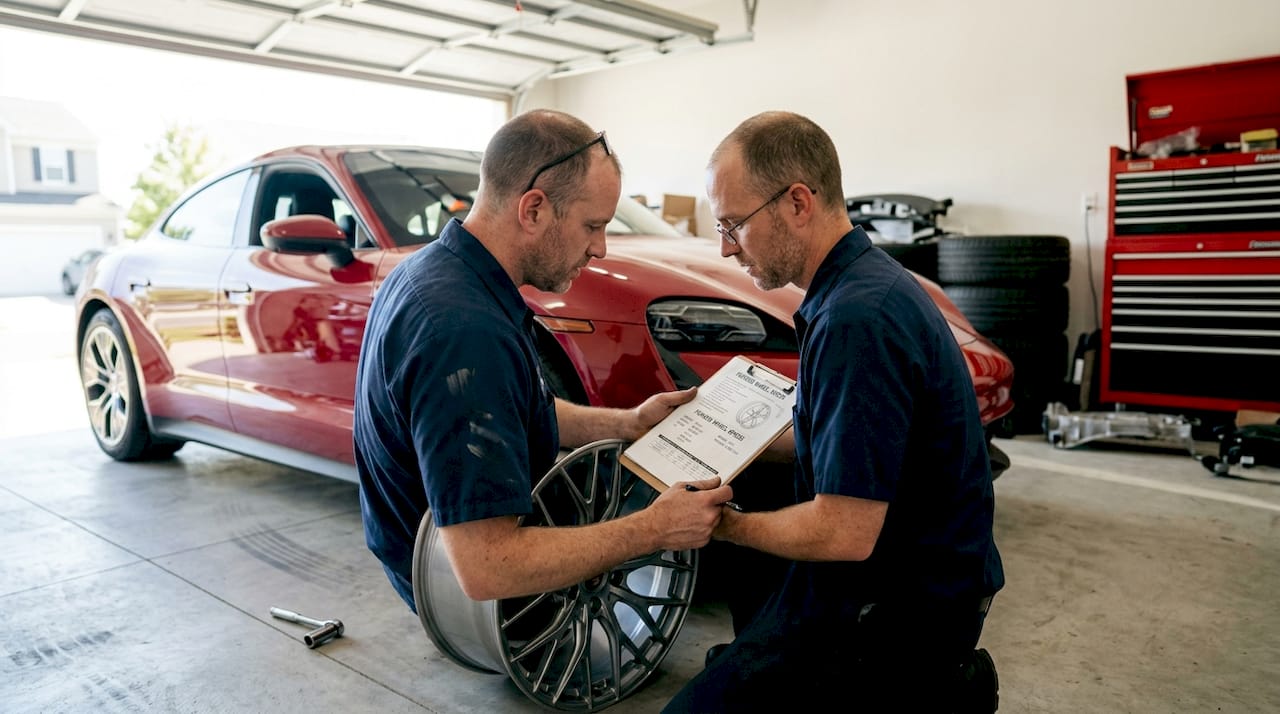
Choosing the right wheels for your Ferrari, BMW M car, or Corvette can feel overwhelming when you’re balancing aggressive aesthetics with safe, precise fitment. One wrong measurement and you risk rubbing, vibration, or even compromised handling on track days. This guide walks you through the essential specifications, staggered versus square setups, position calculations, and performance trade-offs so you can confidently upgrade your luxury or sports car with wheels that look stunning and perform flawlessly.
Table of Contents
- Key takeaways
- Understanding essential wheel fitment specifications
- Staggered and square fitments: tailoring wheels for performance and style
- Calculating wheel position changes and avoiding fitment issues
- Performance implications of wheel weight and design choices
- Explore premium forged wheels and expert installation guides
- Frequently asked questions about wheel fitment
Key Takeaways
| Point | Details |
|---|---|
| Exact fitment specs | Getting bolt pattern, center bore, offset, width, and backspacing correct is essential to prevent vibration, rubbing, or detachment. |
| Offset and backspacing | Offset controls wheel position and must align with the vehicle to ensure clearance from brakes and suspension. |
| Staggered versus square | Staggered wheels improve rear traction on high performance cars while square setups simplify rotation and balance. |
| Vehicle year verification | Always verify fitment against your exact vehicle year and trim level since suspension and brakes can change between model years. |
Understanding essential wheel fitment specifications
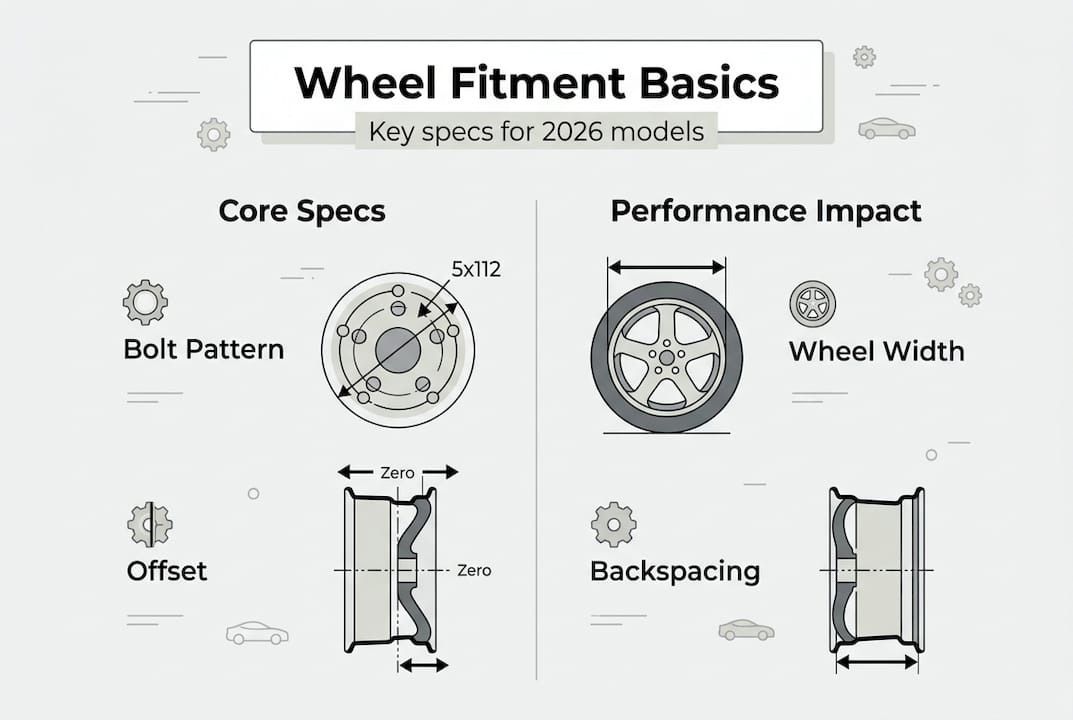
Wheel fitment is determined by key specs: bolt pattern (PCD), center bore, offset (ET), wheel width, and backspacing. Each measurement plays a distinct role in how your wheel mounts to the hub and positions relative to suspension components and fenders. Getting even one spec wrong can lead to vibration, rubbing, or dangerous wheel detachment at speed.
Bolt pattern describes the number of lug holes and the diameter of the circle they form, expressed as 5×112 or 5×120. Your new wheels must match your vehicle’s bolt pattern exactly or they simply won’t bolt on. Center bore is the diameter of the hole in the wheel’s center that fits over the vehicle’s hub. A wheel with a larger center bore than your hub requires hub-centric rings to center it properly and prevent vibration. If the center bore is too small, the wheel won’t fit at all.
Offset controls inward/outward positioning and must match for safety and performance. Measured in millimeters and labeled ET, offset is the distance from the wheel’s mounting surface to its centerline. Positive offset pushes the wheel inward toward the brakes, while negative offset moves it outward toward the fender. Most luxury and sports cars use positive offset between ET35 and ET55 to keep wheels tucked safely inside the fender while clearing big brake calipers.
Wheel width determines how much tire you can fit and affects both grip and clearance. Wider wheels allow wider tires for more contact patch, but they also increase the risk of rubbing against suspension arms or fenders during hard cornering. Backspacing measures the distance from the wheel’s mounting surface to its inner edge and works hand in hand with offset to define inner clearance. You can calculate backspacing using the formula: Backspacing = (Width / 2) + Offset + Hub Thickness.
For example, an 11-inch wide wheel with ET45 offset has roughly 5.5 inches to the centerline, plus 1.77 inches for the offset (45mm converted), yielding about 7.27 inches of backspacing before accounting for hub thickness. Understanding these relationships helps you visualize where the wheel sits and whether it will clear your brake calipers and suspension components. Explore more about wheel customization basics to see how these specs translate into real-world performance gains.
Pro Tip: Always verify fitment specs against your exact vehicle year and trim level, as manufacturers often change suspension geometry or brake package sizes between model years.
Staggered and square fitments: tailoring wheels for performance and style
Staggered fitment means running narrower wheels up front and wider wheels in the rear, a setup favored by rear-wheel-drive sports cars to maximize rear traction and create an aggressive stance. Staggered setups improve traction with narrower front and wider rear wheels on high-performance cars. The C8 Corvette, for instance, typically runs 19×8.5 front and 20×11 rear wheels to plant power through the rear tires while keeping the front end nimble. Ferrari 488 owners often choose 20×9 front and 21×12 rear to balance handling precision with maximum rear grip.
Square fitment uses the same wheel and tire size on all four corners, a configuration that simplifies tire rotation and often improves handling balance on all-wheel-drive or front-heavy platforms. BMW M2 and M3 owners sometimes opt for square 19×10 setups to enable tire rotation and create more neutral handling characteristics. Square setups also reduce understeer on AWD cars by giving the front axle the same contact patch as the rear.

| Vehicle | Front Fitment | Rear Fitment | Setup Type |
|---|---|---|---|
| C8 Corvette | 19×8.5 ET40 | 20×11 ET52 | Staggered |
| Ferrari 488 | 20×9 ET45 | 21×12 ET65 | Staggered |
| BMW G80 M3 | 19×9.5 ET40 | 20×10.5 ET25 | Staggered |
| Porsche 911 GT3 | 20×9 ET51 | 21×12 ET47 | Staggered |
| BMW M2 (custom) | 19×10 ET35 | 19×10 ET35 | Square |
On AWD vehicles, you must keep tire diameter variance below 1% between front and rear to avoid stressing the transfer case and causing premature wear or failure. Calculate rolling diameter for each tire size and confirm the difference stays within tolerance. Many enthusiasts use online fitment calculators to check how different wheel widths and offsets affect poke (how far the wheel sticks out past the fender), track width, and suspension geometry.
Staggered setups deliver that head-turning aggressive look and maximize rear traction for launches and corner exits, but they prevent tire rotation and can increase understeer if front tires wear faster. Square setups sacrifice some rear stance for handling balance and maintenance simplicity. Your choice depends on whether you prioritize aesthetics and straight-line traction or balanced handling and tire longevity. Learn more about different performance wheel styles to match your driving goals.
Pro Tip: Use a digital fitment calculator to model your proposed wheel specs and visualize how changes in width and offset affect track width and fender clearance before ordering.
Calculating wheel position changes and avoiding fitment issues
When you change wheel width or offset, the wheel’s mounting position shifts inward or outward relative to the hub. Width changes split equally inner and outer; 10mm offset shift changes position by 10mm. The formula to calculate position change is: Position Shift = (Width Change / 2) ± Offset Change. For example, upgrading from a 9-inch wheel with ET45 to a 10-inch wheel with ET35 means you added 1 inch (25.4mm) of width, so 12.7mm moves inward and 12.7mm moves outward. The offset decreased by 10mm, pushing the wheel 10mm further outward. Total outward shift is 12.7mm + 10mm = 22.7mm, which could cause fender rubbing if clearance is tight.
Backspacing and offset are two sides of the same coin. Backspacing measures from the mounting surface to the inner wheel edge, while offset measures from the mounting surface to the wheel centerline. Increasing backspacing moves the wheel inward toward the brakes, reducing inner clearance but improving fender clearance. Decreasing backspacing pushes the wheel outward, increasing the risk of rubbing on fenders or fender liners during compression or steering lock.
Common causes of tire rubbing include:
- Excessive negative offset that pushes the wheel too far outward
- Overly wide tires that exceed fender or suspension clearance
- Worn suspension components allowing extra wheel travel
- Lowered ride height reducing compression clearance
- Aggressive camber settings angling the tire into the fender
If you experience rubbing, start by checking tire pressure and ensuring it matches manufacturer specs. Low pressure allows the tire to balloon outward under load. Next, inspect suspension bushings and ball joints for wear that might allow excessive wheel movement. You can often resolve minor rubbing by dialing in 1 to 2 degrees of negative camber, which tilts the top of the tire inward and pulls the outer edge away from the fender. Rolling or pulling the fender lip creates additional clearance without changing wheel specs.
In stubborn cases, switching to a tire with a less aggressive sidewall profile or slightly narrower section width solves the problem. For example, moving from a 285mm tire to a 275mm tire on the same 10-inch wheel reduces outer clearance needs by about 5mm per side. Alignment adjustments can also help by centering the wheel in the fender well and minimizing dynamic rubbing during cornering.
| Issue | Cause | Solution |
|---|---|---|
| Rubbing at full lock | Negative offset too aggressive | Increase offset or narrow tire |
| Inner fender contact | Excessive backspacing | Reduce backspacing or add camber |
| Rubbing over bumps | Lowered suspension, worn bushings | Raise ride height or replace bushings |
| Outer fender contact | Wide tire, insufficient camber | Roll fender or add negative camber |
Check out the forged wheel installation guide for detailed torque specs and mounting procedures that prevent vibration and ensure safe operation.
Pro Tip: Avoid wheel spacers on high-performance cars because they stress wheel studs and bearings, increasing the risk of failure during hard driving or track sessions.
Performance implications of wheel weight and design choices
Reducing rotational mass at the wheels delivers measurable performance gains because the engine must accelerate both the vehicle’s mass and the rotating mass of wheels and tires. Lighter wheels improve acceleration, with 12lb per corner equaling 0.29s faster 0-60 in a Miata. That same weight reduction improves braking response and reduces unsprung mass, allowing the suspension to react faster to road surface changes and maintain better tire contact.
Forged wheels offer the best strength-to-weight ratio, often weighing 30% to 40% less than cast wheels of the same size. A forged 20×10 wheel might weigh 22 pounds, while a cast equivalent tips the scales at 32 pounds. That 10-pound difference per corner equals 40 pounds of rotational mass savings, translating to sharper turn-in, quicker acceleration, and reduced brake fade. Carbon fiber wheels push weight savings even further, with some designs coming in under 15 pounds for a 20-inch wheel, but they carry a premium price and require careful inspection for damage.
Key performance benefits of lightweight wheels include:
- Faster acceleration from reduced rotational inertia
- Improved braking response and shorter stopping distances
- Sharper steering response and turn-in precision
- Better suspension compliance over rough surfaces
- Reduced stress on wheel bearings and suspension components
Brake clearance becomes critical when upgrading to larger brake kits or switching wheel designs. Measure the distance from your caliper to the inner barrel of the wheel to ensure at least 3mm of clearance all around. Many performance brake kits specify minimum wheel diameter and offset requirements, so verify compatibility before ordering. Load ratings matter too, especially for heavier luxury cars or track use. Each wheel should be rated for at least 25% of your vehicle’s gross weight to provide a safety margin under hard cornering and braking loads.
Track tires like BFGoodrich Rival S 1.5 deliver the fastest lap times in the 200TW category, but they require wheels that can handle the extreme lateral loads generated during high-speed cornering. Prioritize brake clearance, load ratings, and forged construction for track wheels to ensure safety and performance under demanding conditions.
Choose wheel designs that balance aesthetic appeal with OEM-plus safety standards, especially for track use where wheel failure can have catastrophic consequences.
Explore racing wheels benefits to understand how premium forged and carbon fiber wheels deliver measurable performance advantages on both street and track.
Explore premium forged wheels and expert installation guides
E6 Carbon specializes in lightweight forged wheels engineered specifically for luxury and sports car applications, from BMW M models to Ferrari and Lamborghini supercars. Our monoblock, multipiece, and beadlock designs deliver the strength and weight savings you need for aggressive street driving or competitive track sessions. Every wheelset undergoes rigorous quality control to meet or exceed OEM safety standards while shedding pounds of unsprung mass.
We provide detailed forged wheel safety inspection checklists and step-by-step installation guides so you can mount your new wheels with confidence. Our AR03 multipiece wheels combine aggressive styling with precision fitment for popular platforms like the G80 M3, C8 Corvette, and 992 Porsche 911. Each design undergoes extensive testing to ensure brake clearance, load capacity, and perfect hub-centric fitment.
Quality and safety drive every design decision at E6 Carbon, ensuring your wheels perform flawlessly whether you’re carving canyons or setting lap records.
Frequently asked questions about wheel fitment
What is the safest way to test wheel fitment before buying?
Use online fitment calculators to model your proposed specs, then confirm with test fitment at a reputable wheel shop. Many shops offer test fitting services where they mount a sample wheel to verify clearance before you commit to a full set.
Can you use spacers safely on high-performance luxury cars?
Spacers stress wheel studs and bearings, increasing failure risk during hard driving. It’s always safer to order wheels with the correct offset from the start rather than relying on spacers to achieve proper fitment.
How does camber adjustment help with wheel clearance?
Adding 1 to 2 degrees of negative camber tilts the top of the tire inward, pulling the outer edge away from the fender and reducing rubbing during compression. This adjustment also improves cornering grip by maximizing tire contact patch during hard turns.
Are forged wheels better for track use than cast wheels?
Forged wheels offer superior strength-to-weight ratios and better resistance to impact damage, making them ideal for track use where wheels endure extreme lateral loads and potential curb strikes. They also reduce unsprung mass for sharper handling response.
How much offset deviation is acceptable for a luxury car upgrade?
Stay within 5mm to 10mm of OEM offset to maintain proper suspension geometry and steering feel. Larger deviations can increase steering effort, accelerate bearing wear, and create clearance issues. Learn more about custom wheels for luxury cars to understand how offset affects handling and aesthetics.