

TL;DR:
- The luxury wheel shipping process involves specialized packing, insurance, and documentation to protect high-value wheels during transit. Proper packaging materials and following a six-step protocol greatly reduce damage risks for domestic and international shipments. Using full-value insurance and timely customs documentation ensures smooth delivery and financial protection for high-value forged or carbon fiber wheels.
The luxury wheel shipping process is defined as the specialized sequence of packaging, carrier selection, insurance, and customs documentation required to transport high-value forged or carbon fiber wheels without damage or financial loss. Standard parcel services are not built for wheels valued in the thousands of dollars. A monoblock forged wheel set for a Mercedes-AMG GT or McLaren 720S can weigh over 80 lbs combined and carry a replacement value that far exceeds what any default carrier liability will cover. Getting this process right means understanding packaging standards, dimensional weight surcharges, and international customs requirements before a single box is sealed.
What does the luxury wheel shipping process require for preparation?
The right materials determine whether your wheels arrive in showroom condition or with contact damage and moisture staining. High-density foam inserts, heavy-duty double-wall corrugated boxes, and ISPM 15 certified pallets form the foundation of any professional packing setup. ISPM 15 heat-treated wooden pallets are mandatory for international shipments. Without them, customs authorities in the EU, Australia, and Canada will hold your shipment for fumigation, adding days and fees to the delivery.
The full materials list for a four-wheel set includes:
- ISPM 15 heat-treated wooden pallets for sea or air freight palletization
- High-density foam cradles cut to wheel diameter and width
- Heavy-duty corrugated boxes rated for the wheel’s actual weight
- Polyethylene moisture barrier wrap to prevent humidity damage during sea transit
- Corner protectors and edge guards for box reinforcement
- Heavy-duty strapping tape and ratchet straps for pallet securing
- Printed labels with shipper, consignee, and HS tariff code
Documentation preparation runs parallel to physical packing. A commercial invoice, packing list, and certificate of origin must be ready before the carrier arrives. Submitting these digitally at least 72 hours before dispatch gives customs authorities time to pre-clear the shipment and prevents holds at the border.
Pro Tip: Photograph every material and its placement before sealing the box. This documentation is your primary evidence if a damage claim is filed.
How to properly pack luxury wheels for domestic and international shipping
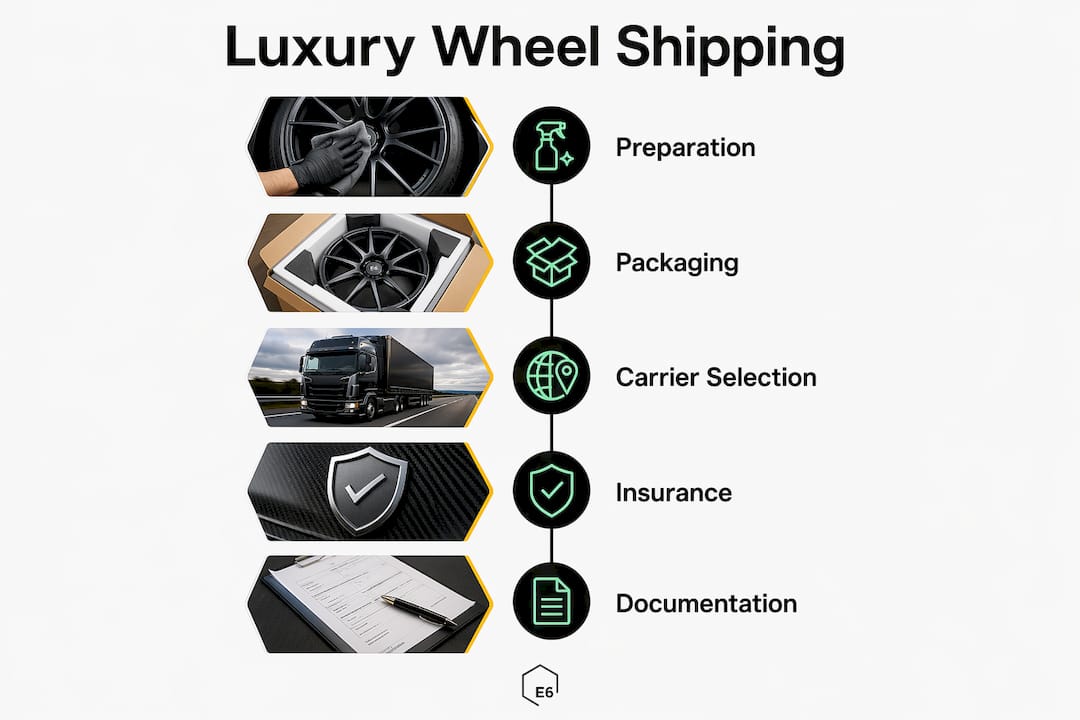
A six-step enterprise-grade packing protocol reduces damage claims by up to 80% compared to ad-hoc packing methods. That figure reflects the real cost of skipping steps: scratched lips, dented barrels, and cracked spokes on wheels that cost more than most cars’ monthly payments.
Follow this sequence for every shipment:
- Measure the wheel set. Record diameter, width, and combined weight. These numbers determine box dimensions and carrier rate calculations.
- Reinforce the box base. Double-layer the bottom with corrugated inserts before placing any foam. A single-layer base collapses under wheel weight during handling.
- Cut and place foam cradles. Each wheel needs a fitted foam cradle that contacts the barrel, not the face or lip. Spoke contact causes pressure marks and finish damage.
- Lower the wheel into position. Place the wheel face-down into the cradle. Never stack wheels face-to-face without a foam separator rated for the combined weight.
- Fill voids and apply moisture protection. Pack all remaining space with foam peanuts or air pillows. Wrap the entire interior in polyethylene sheeting before sealing. Internal movement during sea transit is the leading cause of barrel-to-barrel contact damage.
- Seal and label. Apply at least four strips of heavy-duty tape across every seam. Attach shipping labels, fragile indicators, and “This Side Up” markers on all four vertical faces.
For air freight, the same protocol applies with added attention to dimensional weight. For sea freight via LCL (Less than Container Load), wheels must be palletized and strapped with ratchet straps before the pallet is shrink-wrapped. Never reuse a box that shows crush damage or moisture staining. The structural integrity of a used box is impossible to verify visually.
Pro Tip: Record a short video of the fully packed wheel before sealing. Video timestamps are more difficult to dispute than photos alone during insurance claims.

Which shipping methods offer the best balance of cost and security?
Carrier selection for premium wheel transport depends on three variables: destination, combined weight, and how quickly the wheels are needed. Ground shipping via UPS or FedEx covers domestic routes and works well for sets under 150 lbs. Dimensional weight surcharges apply for sets over 50 lbs, which means the carrier charges based on package volume rather than actual weight. This regularly doubles or triples the quoted rate for large-diameter wheel boxes.
| Method | Transit Time | Relative Cost | Best For |
|---|---|---|---|
| Ground (UPS/FedEx) | 2–7 days | Low to moderate | Domestic, sets under 150 lbs |
| Air freight | 1–3 days | High | Time-sensitive international |
| Sea freight (LCL) | 15–30 days | Low | International, cost-sensitive |
| Freight forwarder | Varies | Moderate | Heavy sets, complex customs |
Sea freight via LCL costs 60–80% less than air freight for high-value wheelsets. The tradeoff is transit time of 15–30 days, which makes it unsuitable for urgent builds but ideal for planned purchases from overseas manufacturers. Freight forwarders specialize in consolidating LCL shipments and managing customs paperwork, making them the right choice for sets that exceed standard carrier weight limits.
For international shipments, Delivered Duty Paid (DDP) shipping terms are the most reliable option. DDP incorporates all import duties and taxes into the upfront cost. The alternative, Delivered Duty Unpaid (DDU), leaves the buyer responsible for unknown fees at delivery, which frequently causes refusal of shipment and return freight charges. When shipping forged wheels to buyers in the EU or Asia, DDP eliminates the most common source of post-sale disputes. For context on how brake kit documentation affects international automotive parts clearance, the same pre-clearance principles apply to wheel shipments.
Why insurance and documentation are non-negotiable for high-value wheels
Standard carrier liability is capped at $100 for most wheel shipments. A set of E6 Carbon monoblock forged wheels for a Lamborghini Huracán or McLaren 720S carries a replacement value that makes a $100 liability cap functionally worthless. Full-value declared insurance is the only protection that matches the actual financial risk.
Required customs documents for international high-end wheel delivery include:
- Commercial invoice with accurate declared value and HS tariff code
- Packing list detailing dimensions, weight, and contents per box
- Certificate of origin confirming manufacturing country
- Bill of lading or airway bill issued by the carrier
Undervaluing a shipment to reduce import duties is a customs violation in most jurisdictions. Beyond the legal risk, undervaluation voids insurance coverage. If a $12,000 wheel set is declared at $500 and arrives damaged, the insurer pays $500.
Specialist logistics providers recommend submitting all customs documentation digitally at least 72 hours before shipping. Pre-clearance reduces border hold time and prevents the most common cause of delayed international wheel shipments: incomplete paperwork flagged at the port of entry.
Common mistakes that damage luxury wheels in transit
Most shipping failures are preventable. The errors below account for the majority of damaged or delayed premium wheel shipments.
- Reusing damaged packaging. A box that survived one shipment may have compromised internal structure. Use new materials every time.
- Underestimating dimensional weight. Large-diameter wheels in oversized boxes trigger surcharges that can double the shipping invoice. Measure and calculate before booking.
- Skipping full-value insurance. Damage risks from cargo shifting remain high regardless of carrier method. The cost of insurance is a fraction of one wheel’s replacement value.
- Incomplete documentation. Missing a certificate of origin or incorrect HS code stops shipments at customs for days.
- No photo or video record. Without pre-shipment documentation, damage claims are nearly impossible to win.
When a shipment arrives damaged, photograph the damage before moving the wheels. File the carrier claim within 24 hours. Most carriers have strict claim windows, and late filing results in automatic denial. Keep all original packaging until the claim is resolved.
Pro Tip: Call the carrier’s freight claims department directly rather than filing online. Phone claims are processed faster and allow you to clarify damage details in real time.
Key Takeaways
The luxury wheel shipping process requires precise packaging, full-value insurance, and accurate customs documentation to protect high-value forged or carbon fiber wheels from damage and financial loss.
| Point | Details |
|---|---|
| Use ISPM 15 certified pallets | International shipments require heat-treated pallets to avoid customs fumigation holds. |
| Follow the six-step packing protocol | Proper packaging reduces damage claims by up to 80% compared to ad-hoc methods. |
| Carrier liability caps at $100 | Standard coverage is insufficient; always purchase full-value declared insurance. |
| Choose DDP for international orders | Delivered Duty Paid terms prevent surprise customs fees and shipment refusals at delivery. |
| Submit documents 72 hours early | Digital pre-clearance is the most effective way to prevent customs delays on international shipments. |
What I’ve learned shipping forged wheels across three continents
The biggest mistake I see repeatedly is treating luxury wheel logistics like standard parcel shipping. Collectors spend months specifying a set of multi-piece forged wheels for a Mercedes-AMG C63 or a Lexus LC500, then hand them to a standard ground carrier in a single-wall box with no foam cradles. The result is predictable.
Rigid internal packaging is not optional for wheels with machined barrel faces or polished lips. Any contact between metal surfaces during transit leaves marks that require professional refinishing. The cost of proper foam cradles and a double-wall box is under $50. The cost of refinishing a scratched forged barrel starts at $300 per wheel.
The industry is moving toward digital documentation and pre-clearance as standard practice, particularly for shipments between the US, EU, and Asia-Pacific markets. Carriers and freight forwarders that offer integrated customs filing are worth the premium over those that do not. Transparency with buyers on shipping terms, declared value, and expected transit time prevents disputes that damage long-term relationships. Ship the wheels the way you would want your own investment shipped.
— E6 Engineering
E6 Carbon forged wheels: built to perform, engineered to ship safely
E6 Carbon designs every forged wheel set with structural integrity as the primary constraint. Monoblock and multi-piece configurations for platforms including Mercedes-AMG, McLaren, and Lamborghini are built to exacting tolerances that demand equally exacting transport care.
Every E6 Carbon wheel ships with fitment-specific documentation and packaging guidance. The forged wheel shipping guide covers carrier selection, insurance requirements, and packing protocols specific to high-value forged sets. For collectors evaluating why material choice affects shipping risk, the breakdown of forged vs. cast construction explains the structural differences that make proper handling non-negotiable. Browse the full E6 Forged wheel catalog to find the right configuration for your build.
FAQ
What is the standard carrier liability for luxury wheel shipments?
Standard carrier liability for wheel shipments is capped at $100, which is insufficient for luxury wheels valued in the thousands. Full-value declared insurance is required for adequate financial protection.
How should I pack wheels for international sea freight?
Wheels shipped via LCL sea freight require ISPM 15 certified heat-treated wooden pallets, high-density foam cradles, and polyethylene moisture barrier wrap to prevent humidity damage during 15–30 day transit.
What does Delivered Duty Paid (DDP) mean for wheel shipping?
DDP means all import duties and taxes are included in the upfront shipping cost. This prevents unexpected fees for the buyer at delivery and eliminates the most common cause of international shipment refusals.
When should I submit customs documents for international wheel shipments?
Submit all customs documents digitally at least 72 hours before dispatch. Pre-clearance reduces border hold time and prevents delays caused by incomplete paperwork flagged at the port of entry.
Does dimensional weight affect luxury wheel shipping costs?
Dimensional weight surcharges apply to wheel sets over 50 lbs with carriers like UPS and FedEx, often doubling or tripling the base shipping rate. Minimizing box dimensions and using freight forwarders for heavy sets reduces this cost significantly.