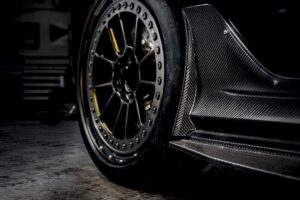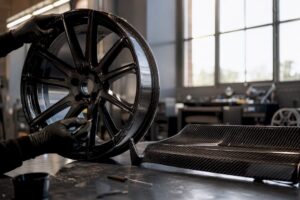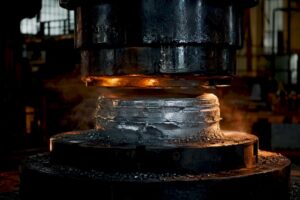
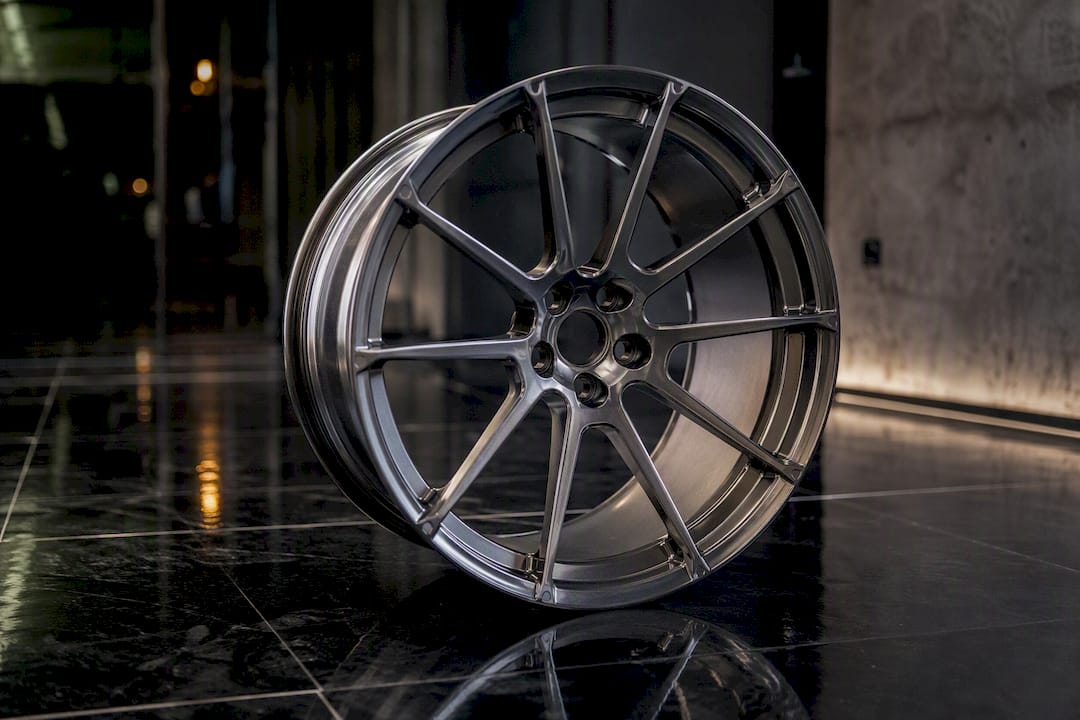
Monoblock forged wheels deliver the best practical strength-to-weight ratio of any common wheel construction, typically shaving 15 to 25 percent off the mass of a cast equivalent while raising stiffness and fatigue resistance at the same time. That gain comes from forging a single 6061-T6 aluminum billet under enormous pressure rather than casting molten metal into a mold. The result is a wheel with continuous grain flow, zero porosity, and a measurable edge in both structural rigidity and rotational mass reduction.
TL;DR:
- Forged monoblock wheels are typically 15 to 25 percent lighter than cast wheels of the same load rating, due to denser grain flow and removal of joint hardware.
- Higher forging tonnage and quality control result in more uniform internal grain structures, which significantly improve fatigue resistance and impact durability.
- Monoblock construction offers tighter runout tolerances and less deflection under load, translating into better handling and reduced energy loss during cornering.
- Properly forged and T6-tempered 6061 aluminum wheels have higher tensile and yield strength, providing a meaningful safety margin and durability in demanding conditions.
- The true performance benefits depend on the manufacturing discipline, with key factors including forging tonnage, billet quality, and precise machining verified through documented test results.
Table of Contents
- What Makes a Monoblock Forged Wheel Structurally Different?
- How Manufacturing Choices Create Real Strength and Weight Advantages
- Measuring Rigidity: Deflection, Load Ratings, and Failure Modes
- Why Weight Savings Matter More Than the Scale Suggests
- The 6061-T6 Advantage: What the Numbers Actually Mean
- Which Platforms Benefit Most From Monoblock Construction?
- What E6 Carbon Brings to Monoblock Engineering
- When Monoblock Forged Wheels Are Worth the Investment
- Why Engineering-First Analysis Beats Marketing Claims
- E6 Forged: Monoblock Engineering Built Around Your Platform
- Sources
- FAQ
What Makes a Monoblock Forged Wheel Structurally Different?
A monoblock forged wheel is machined from a single, solid piece of 6061-T6 aluminum billet that has been compressed under extreme force until its internal grain structure reorganizes along the wheel’s intended load paths. Nothing is bolted, welded, or bonded together. Compare that to a cast wheel, where molten aluminum is poured into a mold and cools with a random, often uneven grain structure, or a flow-formed wheel, where a cast barrel gets spun and stretched under heat to densify the rim area only. Multi-piece forged designs bolt separate forged sections (a face and a barrel) together, which reintroduces joints and fasteners into the load path.
Forging changes the metal at a microscopic level. The aligned grain flow that results from high-pressure compression eliminates the microscopic voids and inconsistent crystal boundaries that plague cast aluminum, a mechanism confirmed by materials research on forging and fatigue resistance. A monoblock design keeps that continuous grain structure intact from the hub bore to the outer lip, with no interruption at a joint.
A few terms matter for understanding what follows in this article:
- Young’s modulus: a measure of a material’s elastic stiffness, or how much it resists deforming under a given load. Higher values mean less deflection for the same applied force.
- Yield strength: the stress point at which aluminum begins to deform permanently.
- Tensile strength: the maximum stress the material can handle before fracturing.
- Runout: the amount a wheel deviates from a perfect circle or flat plane when spinning, measured in thousandths of an inch.
You will see all four again when the discussion turns to how E6 Carbon’s forging and machining choices translate into on-track behavior.
How Manufacturing Choices Create Real Strength and Weight Advantages
Not every forged wheel performs the same, even when two vendors both use the phrase “forged aluminum” in their marketing copy. The difference lives in four production variables, and understanding them lets you evaluate a spec sheet instead of just trusting a sales pitch.
- Forging tonnage. Presses that apply thousands of tons of compressive force produce denser, more uniform grain alignment than lower-pressure processes. Higher tonnage forces the aluminum’s internal structure to follow the die shape more completely, which reduces the risk of micro-voids surviving into the finished part.
- Billet preparation. The raw 6061 billet needs to be free of inclusions and properly sized before it enters the press. Poor billet quality shows up later as inconsistent grain flow, no matter how much tonnage gets applied.
- T6 tempering. After forging, the wheel undergoes a solution heat treatment followed by artificial aging. This is what pushes 6061 aluminum from its raw state into the T6 condition, dramatically increasing yield and tensile strength.
- CNC machining and quality control. Once the blank is forged and tempered, CNC machining removes mass from areas that do not carry primary structural load, typically the inner barrel and spoke faces, while leaving load-bearing sections at full thickness. Precision machining after forging is where a forged blank becomes a genuinely lightweight finished wheel rather than just a strong, heavy one.
Quality control separates serious manufacturers from the rest. Reputable shops inspect for porosity, verify runout tolerances against a fixed specification, and subject finished wheels to radial fatigue, cornering fatigue, and impact resistance testing, the same category of protocols referenced under JWL, VIA, and TUV-style approval frameworks that reputable manufacturers cite in their documentation.
Pro Tip: Ask any wheel manufacturer for their forging tonnage figure and their runout tolerance in writing. If they can’t produce both numbers on request, treat that as a red flag regardless of how the finished wheel looks.
Measuring Rigidity: Deflection, Load Ratings, and Failure Modes
Structural rigidity is not a marketing adjective. It is a measurable property expressed in how much a wheel physically deflects under radial and lateral load, and forged monoblock construction consistently posts tighter deflection numbers than cast alternatives carrying the same load rating.
The physics traces directly back to Young’s modulus and grain continuity. A wheel with aligned, uninterrupted grain flow resists elastic deformation more effectively than one with the same nominal alloy but a random cast grain structure, because the load has a continuous metallic path to travel rather than crossing grain boundaries or, in a multi-piece design, an actual mechanical joint. Fewer interruptions in that load path mean less flex under cornering loads and less energy lost to deformation rather than transferred into the tire contact patch.
Typical performance ranges you will encounter when comparing spec sheets include:
- Static load ratings: forged monoblock wheels in performance sizing commonly carry static load ratings well above the vehicle’s corner weight requirement, with margin built in for dynamic cornering and impact loads.
- Tensile strength ranges: properly forged and T6-tempered 6061 aluminum typically lands in a tensile strength band that gives engineers meaningful margin over cast 6061 or A356 cast alloys.
- Radial and lateral deflection: monoblock designs generally show measurably less deflection under equivalent lateral cornering load than a cast wheel of the same weight class.
A key structural fact: wheel failures under load overwhelmingly occur through fatigue cracking or brittle fracture rather than gradual bending, and forging shifts a wheel’s failure mode toward higher impact resistance because the aligned grain resists crack propagation far better than the randomly oriented grain structure in a casting. A cast wheel that takes a hard curb strike is statistically more likely to crack outright; a forged wheel of comparable weight is more likely to deform slightly and survive the impact.
Manufacturers verify these characteristics with radial fatigue testing (simulating years of straight-line load cycling), cornering fatigue testing (simulating repeated lateral cornering stress), and impact testing (simulating curb strikes and potholes). Consumer-facing guides consistently point to these testing standards as the real differentiator between a genuinely engineered forged wheel and one that simply claims the label.
Why Weight Savings Matter More Than the Scale Suggests
The 15 to 25 percent mass reduction versus cast wheels sounds like a modest number until you understand where that weight comes from and what it costs the car when it’s removed. Every gram shaved off a wheel is a gram of both unsprung mass and rotational inertia, and those two categories affect a car’s behavior in different, compounding ways.
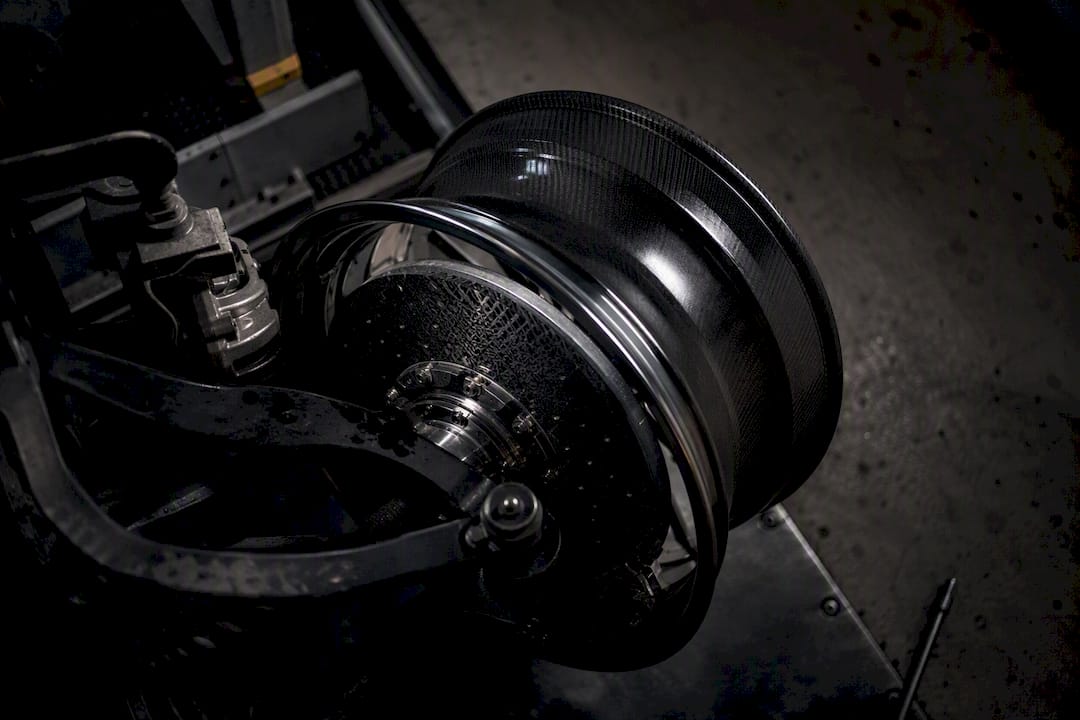
Unsprung mass is everything not supported by the springs, the wheel, tire, brake rotor, and portion of the suspension arms. Less unsprung mass means the suspension can react to a bump or a compression event with less resistance, keeping the tire’s contact patch pressed to the road more consistently.
Rotational inertia is a separate concept: it’s the resistance a spinning object has to changes in its rotational speed. A lighter wheel spins up faster under acceleration, slows down faster under braking, and changes direction faster during transient cornering, because there’s simply less rotating mass for the drivetrain and suspension to fight against.
Monoblock construction typically saves an additional 2 to 4 kilograms per wheel versus multi-piece forged alternatives, a gap that widens as wheel diameter increases, simply because multi-piece designs carry the extra mass of hardware, sealant, and overlapping material at each joint that a one-piece design never needs.
- Track-focused cars feel the gains most in transient direction changes, braking distance consistency, and tire temperature management over long sessions.
- Daily-driven performance cars notice the difference primarily in ride quality and steering response rather than lap times.
- Electric platforms with instant torque delivery are disproportionately sensitive to rotational mass, since reducing rotating weight lets the drivetrain and suspension react before torque has already overwhelmed the tire’s grip.
Pro Tip: If you’re comparing two wheel options with similar published weights, ask for the per-wheel figure rather than a set total. A four-wheel total can mask a meaningful front-to-rear imbalance that changes how the car rotates.
The 6061-T6 Advantage: What the Numbers Actually Mean
6061 aluminum is the dominant alloy choice in forged performance wheels for a reason that has nothing to do with marketing convenience. In its raw, non-tempered state, 6061 aluminum is relatively soft. The T6 designation refers to a specific heat treatment: solution heat treating followed by artificial aging, which precipitates hardening compounds throughout the metal’s structure and substantially raises both yield strength and tensile strength compared to the untreated alloy.
Why this matters for wheel design: a higher yield strength means the wheel resists permanent deformation under repeated cornering and impact loads, while forging on top of that tempering process compounds the benefit. The combination of aligned grain flow from forging and precipitation hardening from T6 tempering is what lets engineers design a wheel that’s simultaneously lighter and structurally tougher than a cast wheel using the same base alloy. Other alloys and treatments exist in aerospace and motorsport applications, but for a road-and-track performance wheel, forged 6061-T6 remains the benchmark that most reputable manufacturers build around, and it’s the standard E6 Carbon specifies across its monoblock lineup.
Which Platforms Benefit Most From Monoblock Construction?
Mercedes-AMG platforms carrying serious power and track-capable chassis tuning are where monoblock construction earns its keep fastest. An AMG owner pushing a car through repeated corner sequences at a track day is loading the wheel with cyclical cornering fatigue stress that a cast wheel simply was not built to absorb over the same service life, and every kilogram removed from rotational mass sharpens throttle response and brake modulation on a chassis already tuned for immediate feedback.
The Lexus LC500’s grand-touring character makes the case slightly differently. Its naturally-aspirated V8 rewards a wheel that spins up cleanly and holds its shape through sustained high-speed cruising and canyon driving, where ride composure matters as much as outright lap time. A monoblock forged wheel keeps the LC500’s suspension geometry working the way its engineers intended, without the added rotational mass of a heavier cast or multi-piece setup dulling the car’s throttle response.
On supercar platforms like McLaren and Lamborghini, reducing unsprung rotational weight allows the suspension to react to road inputs before the chassis has to compensate, sharpening turn-in response on cars whose entire chassis philosophy already assumes minimal rotating mass at each corner.
Selecting the right wheel for your platform comes down to a few practical questions:
- What’s the primary use case, track days, canyon driving, or daily commuting?
- What tire compound and sidewall stiffness will pair with the wheel, since tire choice changes how much of the wheel’s rigidity advantage actually reaches the road?
- What’s your tolerance for repair complexity if a wheel takes serious curb or track damage?
- Has the manufacturer provided documented tensile strength figures, radial fatigue results, and runout tolerances, or only marketing language?
What E6 Carbon Brings to Monoblock Engineering
E6 Carbon builds its wheel program around a “Fitment First” philosophy: every monoblock, beadlock, two-piece, and AeroDisc configuration is engineered against the specific chassis, brake package, and suspension geometry of the target platform before a single billet enters the forging press. That discipline matters more on a Mercedes-AMG or Lexus LC500 than on a generic aftermarket application, because these platforms carry factory-tuned suspension kinematics that a poorly specified wheel can quietly undermine.
The engineering case for monoblock construction rests on three verifiable data points: forging tonnage applied during production, the tensile and yield strength achieved after T6 tempering, and the runout tolerance held during final machining. Anything short of documented numbers on all three is a claim, not a specification.
E6 Carbon also integrates autoclave-cured 2×2 twill carbon fiber components alongside its forged wheel programs, extending the same unsprung and rotational weight reduction philosophy from the wheel to the body. Buyers evaluating any forged wheel vendor should request:
- Forging tonnage and billet alloy certification
- Radial fatigue and cornering fatigue test reports
- Runout tolerance documentation from final machining
- Static load rating and tensile strength figures specific to the wheel size ordered
When Monoblock Forged Wheels Are Worth the Investment
Matching the wheel to the use case keeps the decision simple.
- Track-focused builds: monoblock forged wheels are worth the investment without much debate. The combination of reduced rotational inertia and superior fatigue resistance under repeated cornering loads directly improves lap consistency and reduces failure risk over a season of track days.
- Performance street cars: monoblock construction is worth serious consideration, particularly for AMG, LC500, and supercar owners who want sharper turn-in and braking feel without sacrificing daily usability. Weigh the reduced repairability against a multi-piece wheel’s easier barrel-only repair.
- Daily commuter applications: the rigidity and weight advantage matters less when the driving profile rarely approaches the wheel’s design limits, though the improved impact resistance still offers real peace of mind on rough roads.
Before ordering, request documented tensile and yield figures, radial and cornering fatigue results, and runout tolerances, then schedule a fitment consultation to confirm the spec matches your specific chassis and brake package.
Why Engineering-First Analysis Beats Marketing Claims
Most wheel marketing leans on “forged” as if the word alone guarantees performance, and that’s the biggest blind spot in how buyers evaluate these products. Forging is a manufacturing process with a wide quality range. A low-tonnage forged wheel with poor billet prep can underperform a well-engineered flow-formed wheel, even though “forged” sounds inherently superior on a spec sheet.
The conventional advice to just “buy forged” skips the part that actually determines performance: tonnage, tempering, and machining strategy. Two wheels can share an identical alloy designation and weight and still behave completely differently under cornering fatigue, because one manufacturer controlled grain flow and runout tolerance with real discipline and the other did not.
What should the reader prioritize first? Ask for the numbers before asking for the finish. Tensile strength, runout tolerance, and fatigue test results tell you more about how a wheel will actually perform on a Mercedes-AMG track day or a Lexus LC500 canyon run than any anodized finish or spoke design ever will. The metallurgy and the machining discipline behind the wheel matter more than the marketing language wrapped around it.
— E6 Engineering
E6 Forged: Monoblock Engineering Built Around Your Platform
E6 Carbon manufactures monoblock, beadlock, two-piece, and AeroDisc wheels specifically engineered against the strength-to-weight targets discussed throughout this article, using high-tonnage forged 6061-T6 billets, documented runout tolerances, and fatigue-tested production runs rather than generic off-the-shelf sizing. Every configuration follows the “Fitment First” approach: the wheel gets engineered to the platform’s specific suspension geometry and brake package before machining begins.
For Lexus LC500 owners looking to extend that same weight-reduction philosophy beyond the wheel, the E6 Carbon Elite Kit for Lexus LC500 pairs autoclave-cured carbon fiber body components with the same engineering discipline applied to E6’s forged wheel programs. If you’re ready to specify a monoblock setup for your AMG, LC500, or supercar build, visit the E6 Forged wheels catalog to review available configurations and start an engineering consultation.
Sources
- PMC article on material processing and fatigue (PMC10856444)
- What are forged wheels? — Motor1
- What are forged aluminum wheels? — J.D. Power
- Young’s modulus — Wikipedia
FAQ
Are monoblock wheels strong?
Yes. Forging a single 6061-T6 billet under high tonnage aligns the aluminum’s grain structure along the wheel’s load paths, which measurably improves fatigue resistance compared to cast construction carrying the same nominal strength rating.
Do forged wheels weigh less?
Yes, forged wheels are commonly 15 to 25 percent lighter than cast equivalents at the same load rating, and monoblock designs typically save another 2 to 4 kilograms per wheel over multi-piece forged alternatives by eliminating joint hardware and overlapping material.
Are forged wheels less likely to crack?
Generally, yes. The aligned grain structure created during forging resists crack propagation far better than the random grain orientation found in cast aluminum, which shifts a forged wheel’s failure mode toward gradual deformation rather than sudden fracture under impact.
What are the advantages of monoblock wheels?
Monoblock forged wheels combine lower rotational mass, higher structural rigidity, tighter runout tolerances, and stronger fatigue resistance than cast or multi-piece alternatives, since eliminating joints and hardware keeps the wheel both lighter and structurally continuous from hub to lip.