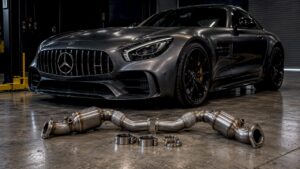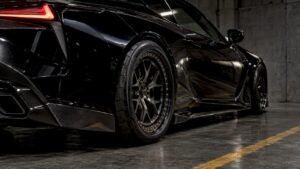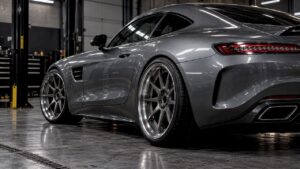
Shaving 12 pounds per corner off your wheel setup sounds modest. But in a Mazda Miata test, that exact reduction cut 0-60 mph times by 0.29 seconds. That is not a cosmetic upgrade. That is a physics problem solved with precision engineering. Bespoke wheels sit at the intersection of weight, strength, fitment, and aerodynamics, and every one of those variables directly shapes how your car performs on track. This article breaks down each factor so you can make smarter decisions about your next wheel upgrade.
Table of Contents
- How bespoke wheels improve race performance
- Strength, stiffness, and weight: forged vs. cast vs. flow-formed wheels
- Tailored fitment: optimizing for your vehicle and track
- Advanced wheel design: FEA, CFD, and aerodynamics in racing
- Modular designs: the advantage of multipiece wheels in motorsport
- Explore premium bespoke wheel options for motorsport
- Frequently asked questions
Key Takeaways
| Point | Details |
|---|---|
| Unsprung mass reduction | Lighter bespoke wheels boost acceleration and handling, cutting lap times noticeably. |
| Superior material strength | Forged and flow-formed wheels deliver unmatched durability and stiffness for racing. |
| Custom fitment benefits | Tailored wheel specs ensure optimal brake clearance, tire fit, and load distribution. |
| Advanced design tools | FEA and CFD maximize wheel strength, aerodynamics, and brake cooling for safe performance. |
| Modular wheel advantages | Multipiece designs allow easy repairs and rapid changes, ideal for motorsport conditions. |
How bespoke wheels improve race performance
Most drivers think about horsepower first. But the weight your suspension has to manage without help from the spring and damper system, known as unsprung mass, has an outsized effect on how your car handles. Every pound you remove from a wheel is felt immediately by the suspension, allowing it to react faster to road surface changes and maintain better tire contact.
Rotational inertia compounds this effect. A heavier wheel resists changes in speed, meaning your engine works harder to accelerate and your brakes work harder to slow down. Lighter wheels spin up faster and shed speed more efficiently. The result is sharper throttle response and shorter braking distances.
“Bespoke wheels reduce unsprung and rotational mass, improving acceleration, braking, handling, and suspension response.”
Here is what that means in practice:
- Faster acceleration: Less rotational resistance means the engine converts more power into forward motion.
- Shorter braking distances: Reduced inertia allows brakes to work more efficiently.
- Improved cornering: Better suspension response keeps tires planted through high-speed turns.
- Reduced fatigue: Lighter wheels reduce stress on bearings, hubs, and suspension components over a race distance.
For context, F1 wheel specifications are engineered to the gram. That level of precision is now accessible in bespoke aftermarket manufacturing, and wheel weight reduction at this level is no longer exclusive to factory race teams.
Now that you understand the dramatic effect wheel weight has on performance, let’s compare materials and construction methods that deliver these gains.
Strength, stiffness, and weight: forged vs. cast vs. flow-formed wheels
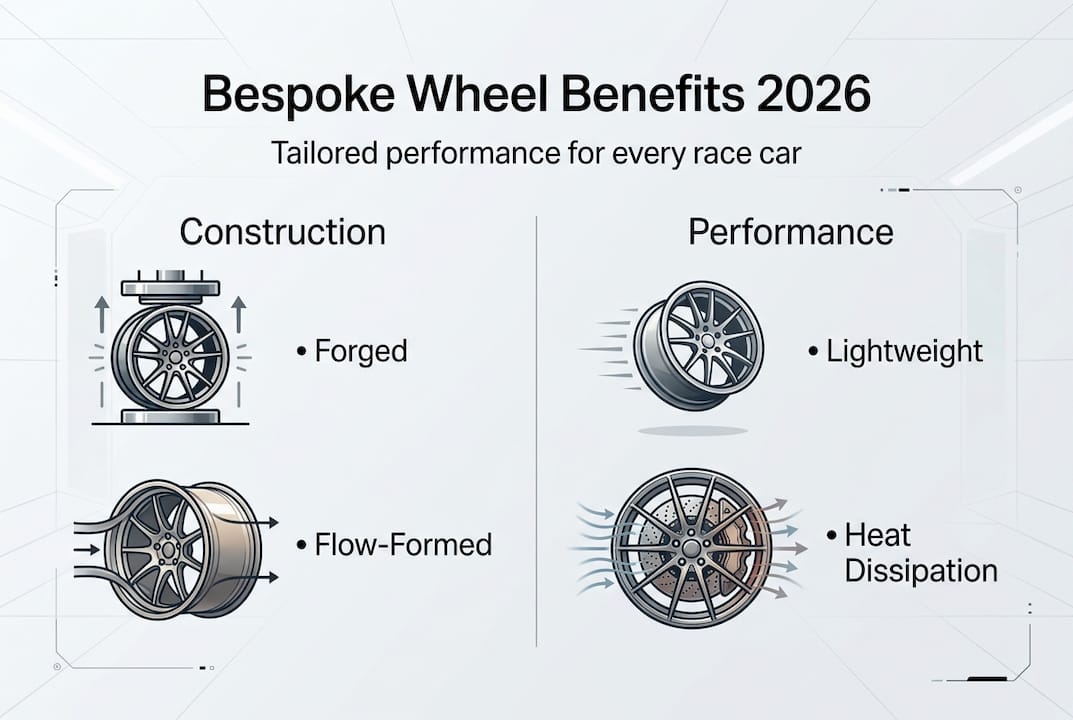
Not all wheels are built the same way, and the manufacturing process determines almost everything about how a wheel performs under load. Cast wheels are poured into molds. They are affordable and widely available, but the grain structure of the aluminum is inconsistent, which limits strength and increases weight.
Flow-formed wheels start as cast blanks but are then spun and pressed under high pressure, aligning the grain structure and thinning the barrel. The result is a wheel that is 10 to 15% lighter and 15 to 20% stronger than a standard cast wheel. Forged wheels go further. The aluminum billet is pressed under extreme force, creating a dense, uniform grain structure that makes forged wheels 2 to 3 times stronger than cast equivalents at a fraction of the weight.
| Wheel type | Strength vs. cast | Weight | Heat dissipation | Best use |
|---|---|---|---|---|
| Cast | Baseline | Heaviest | Moderate | Street/daily |
| Flow-formed | +15 to 20% | 10 to 15% lighter | Good | Performance street |
| Forged | 2 to 3x stronger | Lightest | Excellent | Motorsport/track |
For racing wheel performance, forged construction also handles thermal stress better. Brake heat cycles that would fatigue a cast wheel over time have far less impact on a properly forged unit. This matters in endurance racing where wheels absorb thousands of heat cycles per event.
The F1 wheel materials standard reflects this reality. Every serious racing application gravitates toward forged construction for exactly these reasons.
Pro Tip: If you are choosing between flow-formed and forged for track days, go forged. The weight savings and fatigue resistance pay dividends over a full season of hard use.
With these manufacturing distinctions clear, let’s see how tailored fitment further amplifies bespoke wheel benefits.
Tailored fitment: optimizing for your vehicle and track
A wheel that fits correctly is not just about bolt pattern. Three parameters define proper fitment: offset (how far the wheel face sits from the hub centerline), PCD (pitch circle diameter, the bolt pattern), and hub-centricity (whether the wheel centers on the hub bore rather than the bolts). Get any of these wrong and you introduce vibration, uneven tire wear, and compromised handling.
Custom offsets are especially critical in motorsport. Custom offsets enable brake caliper clearance for high-performance models like the Corvette ZR1 and Aston Martin GT, where aftermarket big brake kits would otherwise conflict with standard wheel geometry.
Here is how tailored fitment affects your setup step by step:
- Offset selection positions the tire correctly within the wheel arch, optimizing scrub radius and steering feel.
- PCD matching ensures the wheel seats flush against the hub, eliminating micro-movement under load.
- Hub-centric fitment transfers load through the hub bore rather than the bolts, reducing stress on fasteners.
- Width and diameter selection determines tire contact patch size and sidewall profile for your specific track surface.
| Vehicle | Application | Key fitment parameter |
|---|---|---|
| Ferrari 488 | Track day | Wide offset, hub-centric |
| Lamborghini Huracan | Time attack | Custom PCD, low offset |
| BMW M4 | Endurance racing | Stepped lip, wide barrel |
| McLaren 720S | Show and track | Flush fitment, custom bore |
Pro Tip: Always verify hub bore diameter before ordering. A wheel that is lug-centric on a high-downforce car will vibrate at speed and can cause premature stud wear. The custom fitment explanation at E6 Carbon walks through every parameter in detail.
Fitment creates the foundation for optimal wheel performance. Now let’s explore the advanced design tools that push bespoke wheels even further.
Advanced wheel design: FEA, CFD, and aerodynamics in racing
Finite Element Analysis (FEA) and Computational Fluid Dynamics (CFD) are simulation tools that allow engineers to stress-test a wheel design before a single piece of metal is cut. FEA maps how stress distributes across the wheel under load, identifying weak points that would only appear after failure in the real world. CFD models how air moves through and around the wheel, which directly affects brake cooling.
The numbers are significant. FEA simulates 1.5x vehicle weight loads, and CFD-optimized spoke geometry can boost brake cooling airflow by 21%. In endurance racing, brake temperatures regularly exceed 900 degrees Celsius. A wheel design that improves airflow to the rotor is not a styling choice. It is a reliability decision.
“Advanced design tools like FEA and CFD optimize for structural integrity, aerodynamics, brake cooling, and minimal flex under extreme loads.”
Here is what these simulations deliver in practice:
- Structural validation: Engineers confirm the wheel survives curb strikes, pothole impacts, and sustained cornering loads before production.
- Weight optimization: Material is removed only where stress analysis confirms it is safe to do so.
- Brake cooling: Spoke angles and window shapes are tuned to direct airflow toward the rotor and caliper.
- Flex minimization: Stiffness targets are set based on the vehicle’s suspension geometry to avoid unwanted deflection under load.
The advanced wheel design process at E6 Carbon incorporates these simulation steps as standard practice, not as optional extras.
These design innovations support reliability at speed. Now let’s examine modular bespoke wheels for adaptability and maintenance in motorsport.
Modular designs: the advantage of multipiece wheels in motorsport
A two or three piece wheel is built from separate components: the center, the inner barrel, and the outer barrel. These are bolted together with aerospace-grade hardware. The advantage is not just aesthetics. It is serviceability.
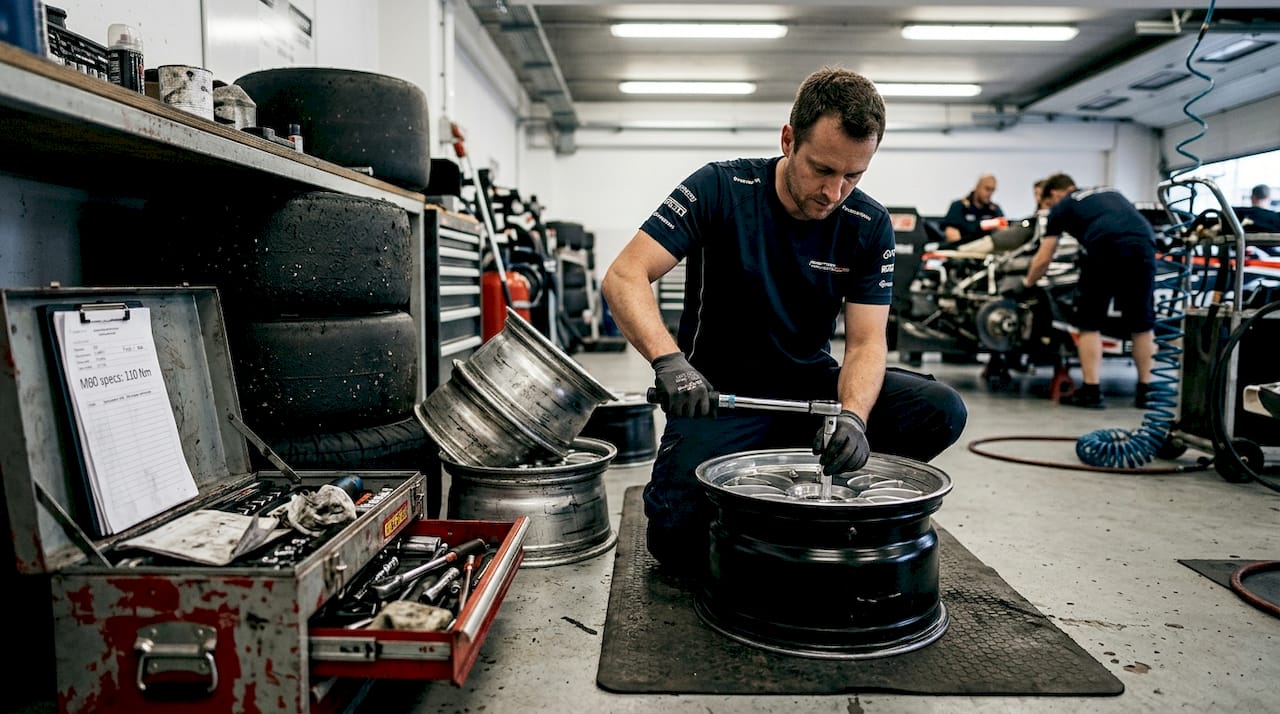
In competitive racing, a curb strike or debris impact can damage the outer barrel without touching the center. On a monoblock wheel, that means replacing the entire unit. On a modular wheel, you replace only the damaged section. Modular designs allow for post-damage replacement, a capability proven effective in the Grand-Am Rolex Series where rapid turnaround between sessions is critical.
Here is how a modular wheel change works at pit speed:
- Remove the damaged wheel assembly from the vehicle.
- Unbolt the outer barrel section using the perimeter fasteners.
- Swap in a pre-assembled replacement barrel.
- Torque fasteners to spec and reinstall the wheel.
- Return to track without waiting for a full wheel replacement.
The broader benefits of modular construction include:
- Custom width adjustment: Barrel width can be changed between events to suit different tire compounds.
- Finish flexibility: Centers and barrels can be finished independently for visual customization.
- Reduced inventory cost: Teams carry spare barrels rather than complete wheel sets.
- Faster repair turnaround: Damaged sections are replaced, not discarded.
- Long-term value: Centers can be reused across multiple barrel configurations.
Pro Tip: Order a spare outer barrel when you buy modular wheels. The cost is a fraction of a full replacement wheel, and it eliminates downtime after an incident.
The AR03 multipiece wheels and AR01 multipiece wheels from E6 Forged are built specifically for this kind of demanding, high-frequency racing use.
With the benefits and practicalities of bespoke wheels covered, let’s connect your race goals to premium wheel solutions.
Explore premium bespoke wheel options for motorsport
Every performance gain covered in this article, from unsprung mass reduction to FEA-validated structural integrity, is built into the wheel lineup at E6 Carbon and E6 Forged. Whether you are building a time attack car, preparing for endurance events, or upgrading a luxury vehicle for track days, the right wheel is the single upgrade that touches every performance variable at once.
Start with the AR03 multipiece product if serviceability and adaptability are your priorities. Before installation, run through the wheel safety inspection checklist to confirm fitment and structural integrity. And when you are ready to mount, the wheel installation guide walks you through every torque spec and sequence. Precision at every step is what separates a fast lap from a safe fast lap.
Frequently asked questions
How do bespoke wheels make a measurable difference in lap times?
Bespoke wheels reduce unsprung and rotational mass, directly improving acceleration, braking, and handling. Empirical tests confirm lap time gains of 0.3 seconds from weight and stiffness improvements alone.
What makes forged wheels superior to cast wheels for motorsport?
Forged wheels are 2 to 3 times stronger than cast equivalents, with better fatigue resistance and lower weight, making them the standard choice for extreme racing conditions.
Why is tailored fitment so important for racing wheels?
Custom fitment ensures correct suspension geometry, brake caliper clearance, and load distribution. Tailored fitment optimizes tire contact and safety for specific vehicles and track conditions.
Are modular multipiece wheels reliable for competitive motorsport?
Yes. Modular wheels are race-proven in Grand-Am Rolex Series competition, enabling rapid tire changes and component replacement to minimize downtime after impacts.
How do FEA and CFD benefit bespoke wheel design?
FEA validates structural integrity under race loads and CFD improves brake cooling airflow. Together, these simulation tools optimize wheel durability and aerodynamic performance under extreme conditions.