TL;DR:
- Titanium hardware, specifically Grade 5 Ti-6Al-4V, is the standard for two-piece forged wheels because it offers aerospace-grade strength and complete corrosion resistance. It reduces weight by 45 percent compared to steel, which improves vehicle response by lowering rotational inertia at the wheel’s outer edge. Proper manufacturing processes, such as hot forging and thread rolling, are essential to ensure titanium hardware’s durability and safety.
Titanium hardware is the engineering standard for two-piece forged wheels because it delivers aerospace-grade tensile strength, complete corrosion immunity, and a weight reduction that directly improves vehicle dynamics. The material of choice is Grade 5 Ti-6Al-4V titanium alloy, the same specification used in jet engine components and structural aerospace fasteners. E6 Forged specifies this alloy across all premium two-piece wheel builds, including fitments for Mercedes-AMG, Lexus LC500, McLaren, and Lamborghini. No other fastener material matches its combination of structural performance and rotational weight savings at the wheel’s outer edge.
Why Grade 5 titanium is the engineering standard for two-piece forged wheels
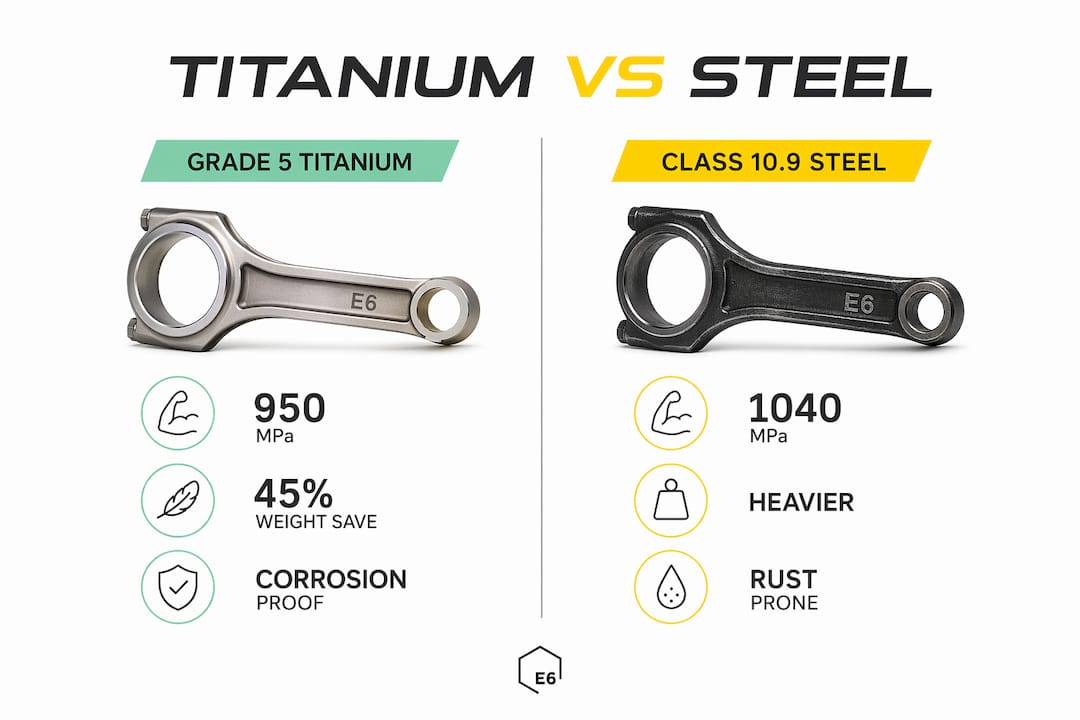
Grade 5 Ti-6Al-4V titanium is defined by its aerospace certification and a minimum tensile strength of 950 MPa, which meets or exceeds Class 10.9 steel bolt requirements. That rating places it firmly in safety-critical territory for wheel fasteners, not just as a cosmetic upgrade. The alloy’s density is roughly 60% that of steel, which is what drives the weight advantage. A standard steel hardware set weighs approximately 2.0 kg, while a Grade 5 titanium set weighs around 1.1 kg, a 45% reduction.
That 45% weight savings is not a minor detail. Every gram removed from the outer edge of a rotating wheel assembly has a disproportionate effect on rotational inertia compared to weight removed from the chassis. Grade 5 titanium also carries a yield strength of approximately 128,000 psi, which means it resists permanent deformation under the high clamping loads required for multi-piece wheel assemblies. Aluminum hardware fails this test entirely. Steel hardware passes on strength but fails on weight and corrosion resistance.
| Property | Grade 5 Titanium | Class 10.9 Steel | Aluminum |
|---|---|---|---|
| Tensile strength | ~950 MPa | ~1,040 MPa | ~310 MPa |
| Density | 4.43 g/cm³ | 7.85 g/cm³ | 2.70 g/cm³ |
| Corrosion resistance | Complete immunity | Requires plating | Moderate |
| Weight vs. steel | 45% lighter | Baseline | 65% lighter |
| Fatigue resistance | High (forged) | High | Low |
Aluminum is lighter than titanium but fails on fatigue and tensile strength. It is not a viable option for structural wheel fasteners. Grade 5 titanium is the only material that clears every threshold simultaneously.
Pro Tip: When sourcing titanium wheel hardware, confirm the alloy designation is Ti-6Al-4V and not Grade 2 commercially pure titanium. Grade 2 is softer and lacks the tensile strength required for safety-critical wheel applications.
How titanium hardware improves performance in two-piece forged wheels
Unsprung weight is the total mass not supported by the vehicle’s suspension, including wheels, tires, brake rotors, and hardware. Reducing unsprung weight improves suspension response because the suspension has less mass to control over road irregularities. Rotational mass at the wheel’s outer edge compounds this effect because it also contributes to rotational inertia, which resists acceleration and deceleration.
Weight savings at the wheel’s outer edge affect rotational inertia more than equivalent weight removed from the center of the wheel. Titanium hardware sits at the bolt circle, which is near the outer diameter of the hub flange. This position means every gram saved there delivers a measurable improvement in how quickly the wheel spins up and slows down. The physics are straightforward: lower rotational inertia means faster throttle response, shorter braking distances, and more precise steering feedback.
The performance gains are most apparent on platforms with high power-to-weight ratios:
- Mercedes-AMG platforms benefit from reduced rotational inertia on wide, heavy wheel packages where hardware weight is amplified across all four corners.
- Lexus LC500 builds gain sharper turn-in response, where the stock wheel package already carries significant unsprung mass.
- McLaren and Lamborghini applications demand the tightest possible weight control at every fastener point, where titanium hardware weight savings directly support the vehicle’s engineering intent.
Switching from steel to Grade 5 titanium hardware on a two-piece forged wheel set reduces total hardware weight by approximately 0.9 kg across all four wheels. That figure is small in absolute terms but significant when measured against the total unsprung mass of a high-performance wheel and tire assembly.
Why forging and thread rolling define true titanium wheel hardware
The manufacturing process separates engineering-grade titanium hardware from cosmetic substitutes. Hot forging and aerospace thread rolling create continuous grain flow aligned to the bolt’s geometry, which significantly increases fatigue resistance under high G-loads. CNC machining from bar stock cuts across the grain structure, creating stress risers that reduce fatigue life under repeated loading cycles.
The correct manufacturing sequence for premium titanium wheel hardware follows this order:
- Billet selection. Start with certified Grade 5 Ti-6Al-4V billet, not Grade 2 or unspecified titanium bar stock.
- Hot forging. The bolt head is hot-forged to align grain flow with the load path, maximizing fatigue resistance.
- Aerospace thread rolling. Threads are rolled, not cut. Rolling compresses the surface layer, adding compressive residual stress that resists crack initiation.
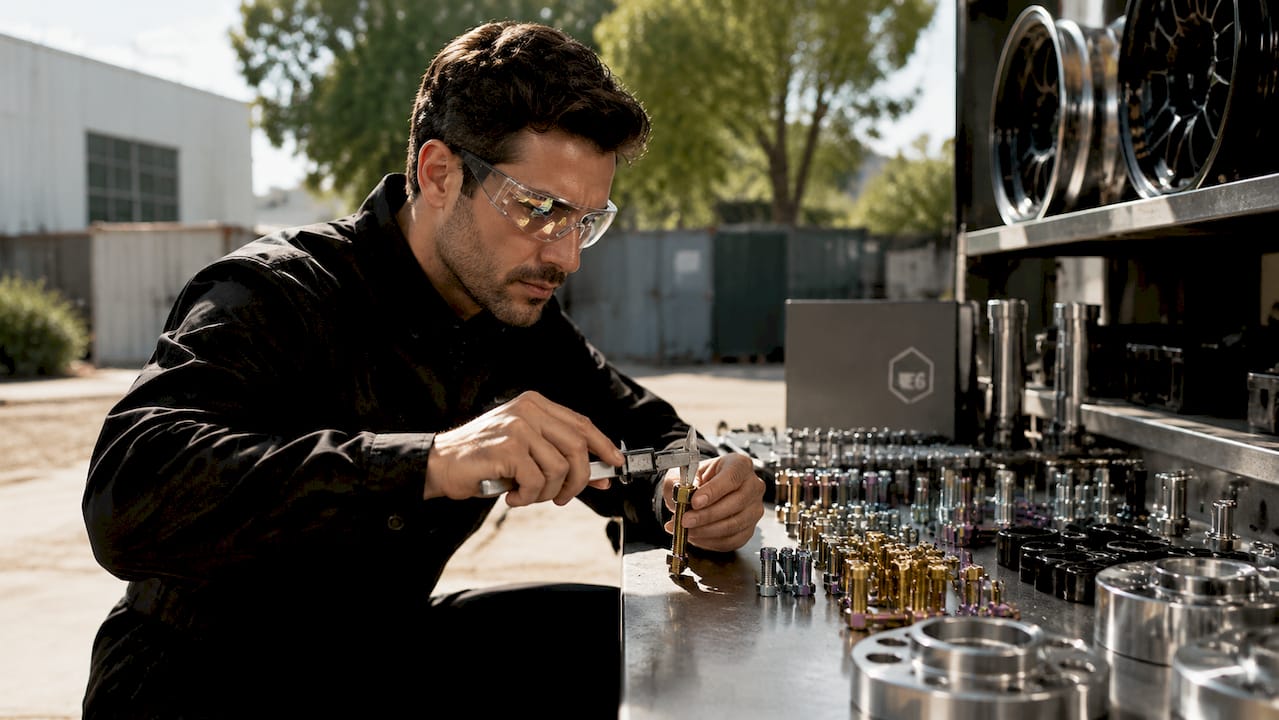
- Dimensional verification. Each bolt is checked against seat geometry specifications, including conical, ball seat, and flat seat variants.
- Surface treatment. Anodizing or passivation protects the surface and enhances appearance without adding meaningful weight.
Mismatched seat geometry between the hardware and the wheel’s bolt seat is one of the most common installation errors. Conical seat hardware in a ball seat wheel creates uneven clamping pressure and risks wheel cracking under load. Always verify seat type before installation.
Pro Tip: Apply a thin layer of anti-seize lubricant to titanium threads before installation. Titanium is prone to galling, a form of adhesive wear where mating metal surfaces bond under pressure. Anti-seize prevents this and allows proper torque readings.
Corrosion resistance and long-term durability of titanium hardware
Titanium’s passive oxide layer forms spontaneously on contact with oxygen and provides complete immunity to rust, road salt, brake dust, and moisture. Plated steel hardware relies on a surface coating that chips, wears, and eventually fails. Once the plating breaks down, corrosion accelerates rapidly. Titanium requires no coating to maintain its corrosion resistance.
The durability advantage extends beyond aesthetics. Corroded steel hardware seizes in the wheel’s bolt seat, making removal difficult and risking thread damage during service. Titanium hardware threads remain clean and serviceable over years of use. Select manufacturers back this with 10-year fading guarantees, a warranty that steel hardware cannot support.
Key durability advantages of titanium hardware include:
- No rust formation under any road condition, including heavy salt exposure in northern climates.
- Consistent torque values at reinstallation because threads do not corrode or seize between service intervals.
- Preserved wheel aesthetics since corroded hardware degrades the visual quality of premium forged wheels.
- Structural integrity over time because the hardware maintains its mechanical properties without degradation from oxidation.
For enthusiasts running wheel coating protection on premium forged sets, titanium hardware eliminates the weakest link in the corrosion protection chain. The wheel coating protects the barrel and face. Titanium protects itself.
Key takeaways
Titanium hardware is the engineering standard for two-piece forged wheels because Grade 5 Ti-6Al-4V delivers 950 MPa tensile strength, 45% weight reduction over steel, and complete corrosion immunity through a single material choice.
| Point | Details |
|---|---|
| Grade 5 alloy is non-negotiable | Ti-6Al-4V meets Class 10.9 steel strength at 45% less weight, making it the only viable fastener material. |
| Rotational weight savings matter most | Hardware weight at the bolt circle reduces rotational inertia, improving throttle response and braking on AMG, LC500, and McLaren platforms. |
| Forging defines hardware quality | Hot-forged, thread-rolled titanium bolts resist fatigue under track loads. CNC-machined bar stock bolts do not. |
| Seat geometry must match | Mismatched conical or ball seat hardware causes uneven clamping and risks wheel damage or fastener failure. |
| Corrosion immunity is structural | Titanium’s passive oxide layer preserves both thread integrity and wheel aesthetics across the hardware’s full service life. |
The engineering choice that separates track hardware from shelf hardware
The most common mistake I see is treating titanium wheel hardware as a cosmetic upgrade. Enthusiasts spend significant money on two-piece forged wheels and then fit Grade 2 titanium or plated steel bolts because they look similar in photos. The structural difference is not visible. It shows up under load at 120 mph on a track day.
At E6 Forged, every two-piece wheel build specifies hot-forged, thread-rolled Grade 5 Ti-6Al-4V hardware. The seat geometry is matched to the wheel design before the hardware is specified, not after. This is not a preference. It is a requirement for any wheel intended for track use on a Mercedes-AMG GT, Lexus LC500, or McLaren 750S. The forged wheel installation guide we publish covers torque specifications and anti-seize application in detail because installation technique matters as much as material selection.
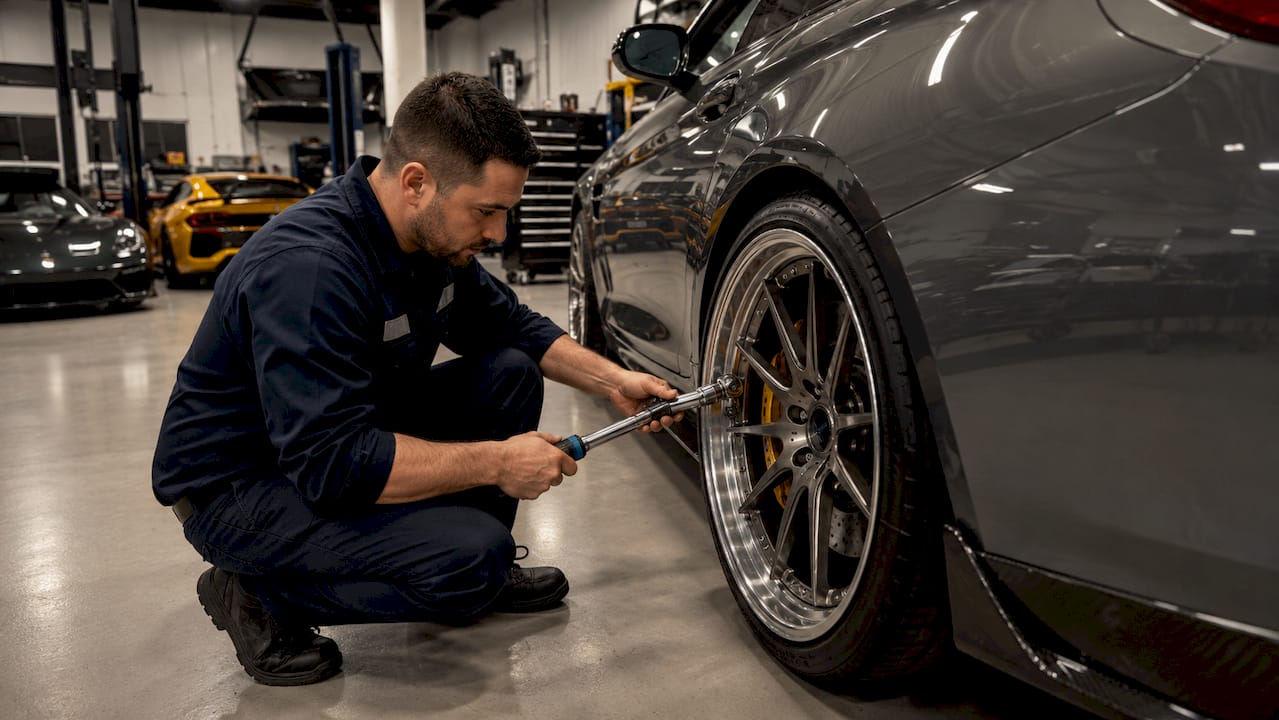
Never use an impact gun on titanium hardware. The friction and thermal properties of titanium differ from steel, and impact guns risk thread stretching that is not visible until the bolt fails. A calibrated torque wrench is the only acceptable tool. This is not overcaution. It is the difference between hardware that performs and hardware that fails.
— E6 Engineering
E6 Forged titanium hardware for premium two-piece wheels
E6 Forged specifies aerospace Grade 5 Ti-6Al-4V titanium hardware across all premium two-piece wheel configurations, including the AR01, AR03, CS5, and JF10 multipiece platforms. Every hardware set is matched to the wheel’s seat geometry and torque specification before delivery.
The engineering precision behind E6 Forged’s wheel builds extends to manufacturing tolerances that directly affect clamping load distribution and long-term structural integrity. Enthusiasts building for the track or the street benefit from understanding how those tolerances interact with hardware selection. The forged wheel tolerances guide covers this in full, from runout specifications to hardware torque sequencing. For enthusiasts ready to spec a complete two-piece forged wheel build, the E6 Forged wheel catalog provides full fitment data for Mercedes-AMG, Lexus LC500, McLaren, and Lamborghini platforms.
FAQ
What is Grade 5 Ti-6Al-4V titanium hardware?
Grade 5 Ti-6Al-4V is an aerospace-certified titanium alloy with a minimum tensile strength of 950 MPa and a density roughly 60% that of steel. It is the standard alloy for structural fasteners in wheel and aerospace applications.
How much weight does titanium hardware save over steel?
A full set of Grade 5 titanium wheel hardware weighs approximately 1.1 kg compared to 2.0 kg for a standard steel set, a reduction of 45% across all four wheels.
Why does rotational weight matter more than static weight?
Rotational mass at the wheel’s outer edge resists changes in speed more than equivalent static weight because it contributes to rotational inertia. Reducing it improves throttle response, braking performance, and steering feedback.
Can I install titanium wheel hardware with an impact gun?
No. Impact guns risk thread stretching on titanium due to its different friction and thermal properties compared to steel. Always use a calibrated torque wrench and apply anti-seize lubricant to the threads before installation.
Does seat type matter when choosing titanium hardware?
Yes. Conical, ball seat, and flat seat hardware must match the wheel’s bolt seat geometry exactly. Mismatched seats create uneven clamping pressure that can crack the wheel or cause hardware failure under load.