TL;DR:
- High-performance wheels must be engineered with robust materials and manufacturing processes like forging to ensure longevity under stress. Fatigue cracking from repeated impacts and loads is a primary failure risk that can lead to sudden wheel failure, especially during spirited driving or off-road use. To ensure safety and performance, buyers should verify certification, fatigue data, proper design, and conduct regular inspections.
When you drop serious money on a high-performance vehicle, it’s tempting to treat wheels as a finishing touch rather than a safety-critical component. That assumption is where things go wrong. Not all wheels are engineered equally, and a wheel that looks stunning on a showroom floor can still carry hidden structural weaknesses that only reveal themselves under real-world stress. Wheel strength affects everything from how your car handles a fast corner to whether you make it home after an aggressive track session. This guide gives you the full picture, covering fatigue, materials, compliance, and the specific steps to make a smarter choice.
Table of Contents
- The hidden risks: What happens when wheel strength falls short
- Engineering strong wheels: Key factors and cutting-edge strategies
- Balancing strength and ride quality: The compliance tradeoff
- How to choose strong wheels that truly deliver
- The uncomfortable truth most drivers ignore about wheel strength
- Explore the next level in safety and performance wheels
- Frequently asked questions
Key Takeaways
| Point | Details |
|---|---|
| Wheel strength prevents failure | Strong wheels resist fatigue and cracking from repeated stress, safeguarding safety and performance. |
| Optimized design balances weight | Modern engineering can nearly double fatigue life while reducing weight so you don’t compromise speed for safety. |
| Too much stiffness has drawbacks | Excessively stiff wheels can harm comfort and road traction, making balance essential. |
| Check for real certifications | Select wheels that meet fatigue standards and show authentic test certifications, not just brand claims. |
| Match wheels to your driving | The strongest wheel may not fit every need—choose strength and compliance levels for your usage and road conditions. |
The hidden risks: What happens when wheel strength falls short
Performance and luxury car owners tend to focus on brake upgrades, suspension tuning, or power figures. Wheels often get evaluated by looks and weight alone. But the structural integrity of a wheel is the foundation that every other performance upgrade builds on. Get it wrong, and you’ve built a fast car on a fragile base.
Fatigue cracking is the primary failure mode that concerns engineers. It describes the progressive, invisible cracking that develops inside a wheel after it absorbs thousands of repeated stress cycles. Each pothole impact, each hard cornering load, each braking force adds microscopic damage that compounds over time. The crack propagates and grows under continued load until the wheel can no longer hold together. According to fatigue research on aluminum wheels, this cracking originates from repeated stress events such as off-road driving and heavy loading, and it grows steadily with each cycle.
“A wheel doesn’t announce when it’s about to fail. It simply does.”
The scenarios where fatigue failure risk peaks include:
- Track days and spirited driving: Lateral cornering loads and hard braking multiply stress on the wheel structure well beyond normal street use.
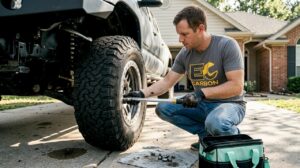
- Off-road and mixed-surface driving: Unpredictable impacts from rocks, ruts, and uneven terrain concentrate force at the wheel’s weakest points.
- Heavy loads: Carrying maximum payload or towing forces wheels to operate at the upper edge of their design envelope.
- Pothole strikes at speed: A single high-energy impact can initiate a crack that later propagates over hundreds of subsequent stress cycles.
Research on aluminum wheel fatigue testing revealed that cracks appeared in structurally compromised wheels after as few as 40,000 load cycles. On a performance vehicle used regularly, 40,000 cycles is not a distant number. This is precisely why understanding the engineering behind your wheels matters, not just their appearance or their price point.
Exploring the relationship between wheel design and performance reveals that structural integrity and aesthetic choices are deeply connected. Spoke geometry, hub thickness, and material distribution all play direct roles in how loads are managed.
Engineering strong wheels: Key factors and cutting-edge strategies
Knowing the risks, drivers should understand how wheel makers defend against failure and how the right engineering can transform wheel performance. The difference between a wheel that lasts and one that doesn’t often comes down to decisions made long before the wheel leaves the factory.
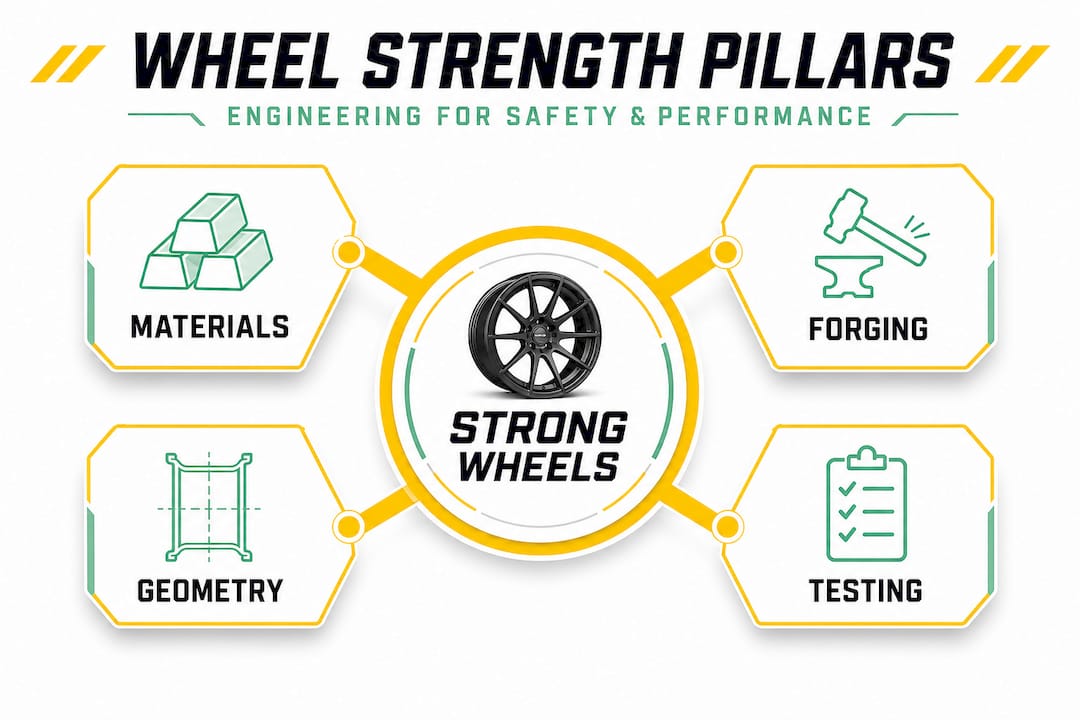
Modern wheel engineering relies on four core pillars: material selection, forging process, geometric optimization, and defect prevention. Forged aluminum wheels start as a solid billet that is compressed under extreme pressure, aligning the grain structure of the metal for superior strength relative to cast alternatives. Cast wheels, by contrast, can trap microscopic air pockets during production that become initiation sites for fatigue cracks.
Here’s how traditional and optimized wheel designs compare in practical terms:
| Factor | Traditional wheel | Optimized wheel |
|---|---|---|
| Fatigue life (cycles) | ~100,000 | ~198,000+ |
| Weight reduction | Baseline | Up to 6.2% lighter |
| Defect tolerance | Lower | Higher |
| Manufacturing cost | Lower | Higher upfront |
| Long-term value | Moderate | Significantly better |
Engineering optimization can increase fatigue life by 98% while simultaneously reducing weight by 6.2%, all while meeting international safety standards. That’s not a marginal improvement. That’s a fundamentally different product.
Here’s a practical framework for evaluating wheel strength before you buy:
- Verify the manufacturing method. Forged wheels offer superior grain alignment over cast alternatives. Monoblock forged designs eliminate the joint vulnerabilities present in multi-piece assemblies that use adhesives or fasteners under load.
- Check fatigue life ratings. Reputable manufacturers publish fatigue cycle data from standardized tests. Ask for it specifically. If a manufacturer can’t provide it, that tells you something important.
- Examine spoke geometry. Thicker spoke roots and curved transitions reduce stress concentration compared to sharp junctions where cracks love to start.
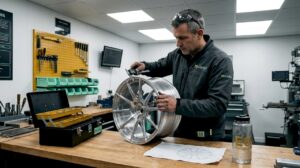
- Research quality control processes. X-ray inspection, dye penetrant testing, and computerized simulation during design phase are signs that a manufacturer takes structural integrity seriously.
- Look for certifications. JWL (Japan Light Alloy Wheel) and VIA certification involve independent testing that covers both rotary bending fatigue and radial load fatigue requirements.
Pro Tip: When a brand lists wheel weight but provides no fatigue data or certification details, that’s a red flag. The lightest wheel is worthless if it cracks after six months of real driving.
For a deeper view on how high-strength wheels deliver tangible benefits, understanding performance wheel upgrades helps frame the engineering decisions behind each design choice. Wheel customization and strength are not mutually exclusive, and the best products prove that. Drivers who want racing-level durability should also review what racing spec wheel benefits actually look like in practice. Following solid wheel maintenance best practices also protects your investment once you’ve made the right choice.
Balancing strength and ride quality: The compliance tradeoff
While strength is vital, it’s not the only factor. A truly high-performance wheel gets the balance exactly right between rigidity and the ability to flex slightly under road input.

Compliance in a wheel means its capacity to absorb small variations in the road surface without transmitting every jolt directly into the suspension and chassis. A wheel that is too stiff transfers more road input to the tire, which then has to absorb forces it was never designed to handle alone. The result is a harsher ride, accelerated tire wear, and in some cases reduced traction on broken surfaces.
Excessive stiffness may reduce compliance, forcing tires to absorb more road input and affecting both comfort and traction. This is a real engineering compromise, not a minor quibble.
Consider these consequences of over-stiff wheel design on road cars:
- Increased vibration transfer: Feedback that should be dampened reaches the chassis, steering column, and driver more intensely.
- Uneven tire wear: The tire deforms irregularly when it must compensate for a wheel that offers no flex, leading to premature wear on specific tread zones.
- Reduced wet-surface grip: On textured or damp roads, a non-compliant wheel leaves less of the tire contact patch in consistent contact with the tarmac.
- Driver fatigue on long journeys: A harsher, less forgiving ride makes extended driving genuinely more tiring.
Here’s a quick comparison of what different applications typically prioritize:
| Wheel application | Stiffness priority | Compliance priority | Best suited for |
|---|---|---|---|
| Track-only race wheel | Very high | Low | Smooth circuit surfaces |
| Street performance wheel | High | Moderate | Mixed road conditions |
| Gran Turismo/luxury | Moderate | High | Highway and city driving |
| Off-road performance | High at rim | Moderate | Uneven terrain |
Pro Tip: If you drive your performance car on a mix of highways, city streets, and occasional track days, prioritize a street performance wheel with documented compliance ratings rather than a race-only specification. The race spec wheel will punish you on public roads long before it ever impresses you on the circuit.
Understanding the full range of carbon wheel types helps clarify which designs prioritize compliance, outright strength, or a true balance of both. Separating fact from fiction on carbon fiber wheel benefits and myths is also worthwhile before committing to a specific material choice.
How to choose strong wheels that truly deliver
Clarity on the right balance primes you to take effective action. Here’s a structured approach to selecting wheels that will actually perform as promised over years of real use.
Your pre-purchase checklist:
- Confirm JWL, VIA, or equivalent third-party fatigue certification
- Request published fatigue cycle test data from the manufacturer
- Verify the manufacturing process: forged is preferred over cast for performance applications
- Check that the wheel’s load rating meets or exceeds your vehicle’s maximum axle weight
- Confirm the offset, bolt pattern, and center bore match your specific vehicle
Red flags to watch for in wheel marketing:
- Weight claims with no corresponding fatigue data
- “Race inspired” language without actual motorsport testing credentials
- No mention of quality control or inspection processes
- Warranty terms that exclude fatigue or structural failure
- Suspiciously low prices for claimed forged construction
Once you’ve purchased your wheels, the work isn’t finished. Here are the steps to maintain structural integrity over time:
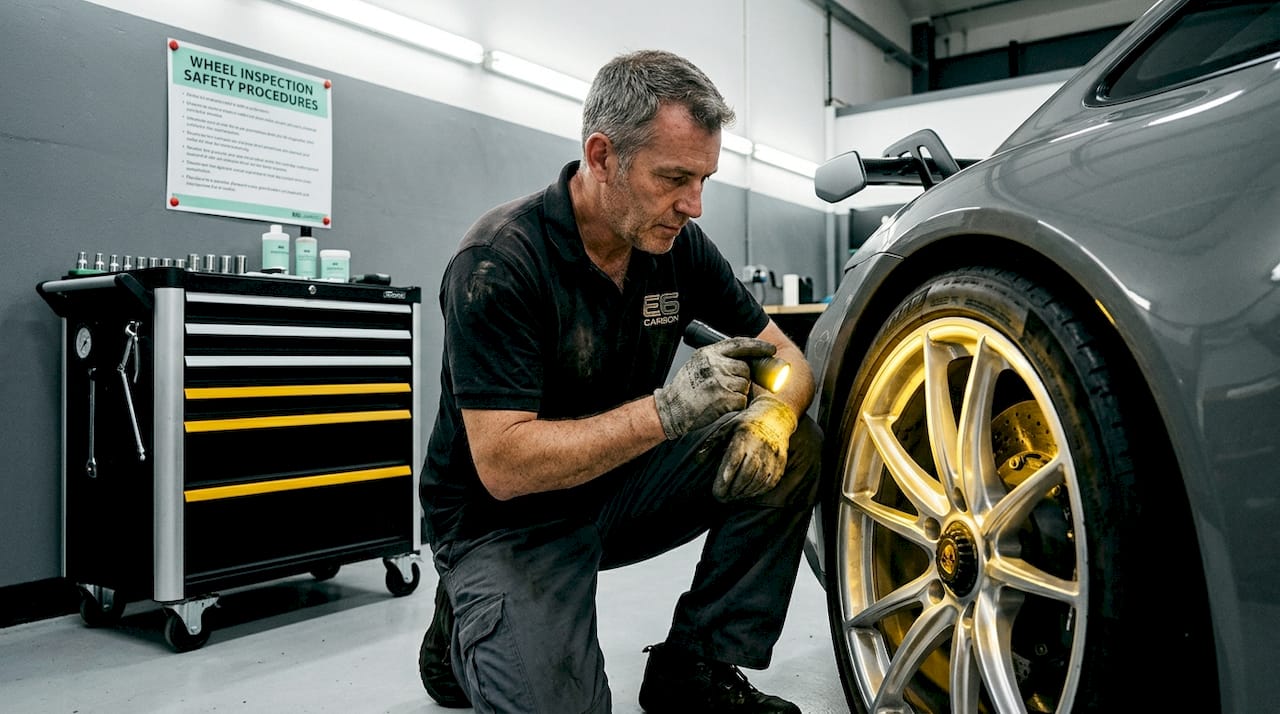
- Inspect visually after every track event or off-road excursion. Look for hairline cracks near the spoke roots and around the bead seat area.
- Check torque on wheel fasteners at regular intervals. Loose fasteners allow micro-movement that accelerates fatigue.
- Monitor for unusual vibrations. A new vibration at speed, especially when it wasn’t present before, can indicate a developing fatigue crack or impact deformation.
- Avoid kerb strikes. High-energy lateral impacts from curbs are among the most common initiators of fatigue cracking in aluminum wheels.
- Refinish and repair only through approved methods. Welding a cracked wheel is not a structural repair. A cracked wheel needs replacement, full stop.
For more guidance on making the right selection, reviewing resources on selecting performance wheels gives you a deeper frame of reference. The wheel fitment guide for luxury and sports cars addresses the compatibility details that matter beyond raw strength numbers. And once your wheels are fitted, the performance wheel finish guide covers how coating choices can also influence long-term durability.
The uncomfortable truth most drivers ignore about wheel strength
Here’s what decades of performance engineering make clear: most drivers, even experienced enthusiasts, evaluate wheels the same way they evaluate clothing. They look at the cut and the color before asking whether it will hold up under pressure.
The uncomfortable reality is that the premium badge on a wheel tells you nothing about its fatigue life. We’ve seen visually stunning, expensive wheels leave the factory with design shortcuts that show up as cracks after two seasons of hard use. And we’ve seen conservatively styled, properly engineered wheels survive abuse that would destroy something twice as expensive.
Buyers who make sharp choices look past the catalog photos and ask harder questions. What is the documented fatigue cycle rating? What quality control processes exist? Has this wheel been tested on a vehicle with similar power and weight to mine? Those questions separate serious buyers from everyone else.
There’s also a longer-term calculation that most drivers skip. A wheel that fails on a track or a highway doesn’t just cost you a replacement wheel. It costs you the tire, potential suspension damage, the risk of losing control at speed, and everything that follows from that. The price difference between a genuinely engineered wheel and a visually appealing shortcut is nothing compared to the cost of failure.
When you understand the engineering, you stop shopping for wheels and start investing in them. That mindset shift is what separates drivers who get exceptional performance from those who just look like they do. Exploring the genuine value of performance wheel upgrades with that lens makes the right choice far more obvious.
Explore the next level in safety and performance wheels
The knowledge you now have about fatigue life, compliance, forging, and certification puts you ahead of most buyers. Putting that knowledge to work means finding wheels and support that match the standard you’re looking for.

At E6 Carbon and E6 Forged, every wheel in our catalog is built around the principles covered in this guide: forged construction, documented strength, and real-world tested durability. Start with our guide on forged wheel safety to learn exactly what to check before and after installation. If you’re ready to upgrade across the board, our roundup of top performance upgrades for luxury cars gives you a clear roadmap. And if you want to see our engineering in action, the AR03 multipiece wheels represent exactly what optimized design, fatigue-rated construction, and precision fitment look like together on a serious performance build.
Frequently asked questions
How does wheel strength affect daily driving safety?
Strong wheels resist fatigue cracking under load, reducing the risk of sudden failure from common hazards like potholes, heavy loads, or hard cornering on public roads.
Can strong wheels also be lightweight?
Yes. Properly optimized engineering can boost fatigue life by 98% while reducing weight by 6.2%, so you don’t have to sacrifice one for the other.
Is stiffer always better in wheel design?
No. Excessive stiffness reduces compliance, which forces tires to absorb more road impact, resulting in a harsher ride and potentially reduced grip on uneven surfaces.
What are signs of potential wheel fatigue or failure?
Visible hairline cracks near spoke roots, sudden air pressure loss, and new vibrations at highway speed are all early indicators of developing fatigue damage that require immediate inspection.
How often should performance wheels be inspected?
After any track event, off-road use, or heavy-load trip, inspect your wheels immediately. For high-performance street cars, a thorough annual inspection is the minimum responsible standard.