TL;DR:
- Flow forming sits between cast and forged wheels, offering high strength and weight savings at a lower cost. The process mechanically elongates and aligns aluminum grain, resulting in a durable, lightweight barrel suitable for street and track use. While not as strong as full forging, high-quality flow formed wheels provide excellent performance, design flexibility, and value for performance enthusiasts.
Most enthusiasts believe the wheel market splits cleanly into two camps: budget cast and premium forged. That assumption leaves out one of the most technically interesting manufacturing methods in the modern wheel industry. Flow forming sits squarely between those two extremes, delivering strength and weight savings that rival forged options at a price point far closer to cast. Understanding how the process works, where it outperforms the competition, and where its limits lie will change how you spec your next build.
Table of Contents
- What is flow forming? The science behind the process
- Inside the machine: Flow formed wheel production
- Comparing flow formed wheels: Pros, cons, and use-cases
- Application tips: How to choose and care for flow formed wheels
- What most enthusiasts miss about flow formed wheels
- Level up your build with advanced wheel solutions
- Frequently asked questions
Key Takeaways
| Point | Details |
|---|---|
| Flow forming defined | Flow forming uses advanced rolling techniques to create stronger, lighter wheels than simple casting. |
| Production advantages | Specialized flow forming machinery ensures wheel precision and quality for performance use. |
| Cost-performance balance | Flow formed wheels offer a sweet spot between affordable cast and premium forged wheels. |
| Smart buyer guidance | Matching your driving style and ensuring proper maintenance maximizes wheel benefits. |
What is flow forming? The science behind the process
Casting pours molten aluminum into a mold. Forging hammers or presses solid billets under enormous force. Flow forming does something fundamentally different: it starts with a cast blank and then mechanically works the barrel of the wheel under heat and pressure using hardened rollers. The result is a wheel that retains the design freedom of casting at the center while achieving a barrel section with grain structure much closer to forged aluminum.
“Flow forming is a more aggressive form of spin forming using multiple rollers and controlled plastic deformation, making it distinct from standard spinning techniques.”
The distinction between flow forming and spin forming matters. Spin forming bends and reshapes material without significantly changing its thickness or internal grain. Flow forming applies far greater force, thinning the barrel wall with precise control while simultaneously elongating and aligning the aluminum grain along the stress axis. The grain alignment is what delivers the strength improvement, and it is why flow formed barrels handle impact and fatigue loads better than an equivalent cast barrel of the same weight.
Think of it like pulling taffy. When you stretch a cast slab, the crystalline structure of the aluminum realigns in the direction of stretch. The material gets thinner, but each unit of remaining material carries more structural integrity because the grain runs parallel to the loading direction rather than in a random cast pattern.
How does wheel design and performance factor into this? A lot. Flow forming lets designers specify a thinner, lighter barrel without sacrificing the load rating, which creates room to add visual complexity to the spoke and center design that would otherwise eat into the weight budget.
Key signs of a quality flow formed wheel:
- Uniform barrel wall thickness with no visible seams or cold shuts
- Consistent surface finish across the entire barrel interior
- Weight that matches or beats published specs for the diameter and width
- Certification markings (JWL, VIA, TUV) visible on the backpad
Pro Tip: Weigh any flow formed wheel before you mount it. Reputable manufacturers hit tight weight tolerances. If a wheel is noticeably heavier than the spec sheet says, that is a signal the flow forming process was inconsistent or the barrel was not worked sufficiently.
Inside the machine: Flow formed wheel production
With the basics in place, it’s time to look inside the machines that make flow forming possible and see how the process unfolds from start to finish.
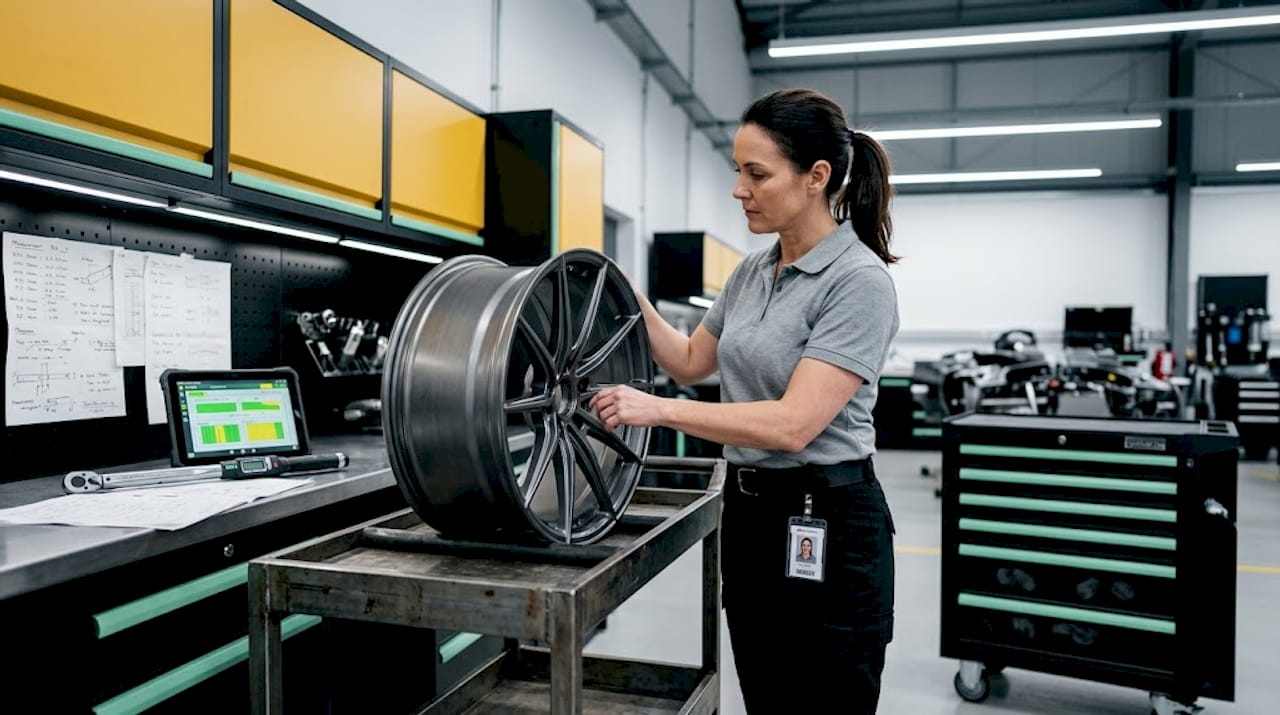
Flow-formed wheel production relies on specialized CNC-controlled vertical and horizontal flow forming machines that manage roller pressure, feed rate, and mandrel speed simultaneously. Modern equipment integrates real-time feedback loops, meaning the machine adjusts roller force mid-cycle to maintain the programmed wall thickness within fractions of a millimeter.
The production sequence follows these steps:
- Cast the blank. A low-pressure cast preform, slightly thicker than the finished wheel, is produced using the target alloy. Typically A356 aluminum is used for its favorable casting and forming characteristics.
- Heat the blank. The preform is brought to a specific temperature window where the aluminum is ductile enough to flow under roller pressure without cracking.
- Mount on the mandrel. The heated blank locks onto a precision mandrel that matches the final inner profile of the barrel.
- Apply the rollers. Multiple CNC-controlled rollers press against the outer surface while the mandrel spins. The rollers travel axially, thinning and elongating the barrel to its final dimensions.
- Heat treat. A T6 or T5 heat treatment cycle relieves internal stress and maximizes the mechanical properties of the worked aluminum.
- Machine and finish. CNC lathes and mills cut the final bolt circle, center bore, and any decorative machining. Powder coat, paint, or polished finishes are then applied.
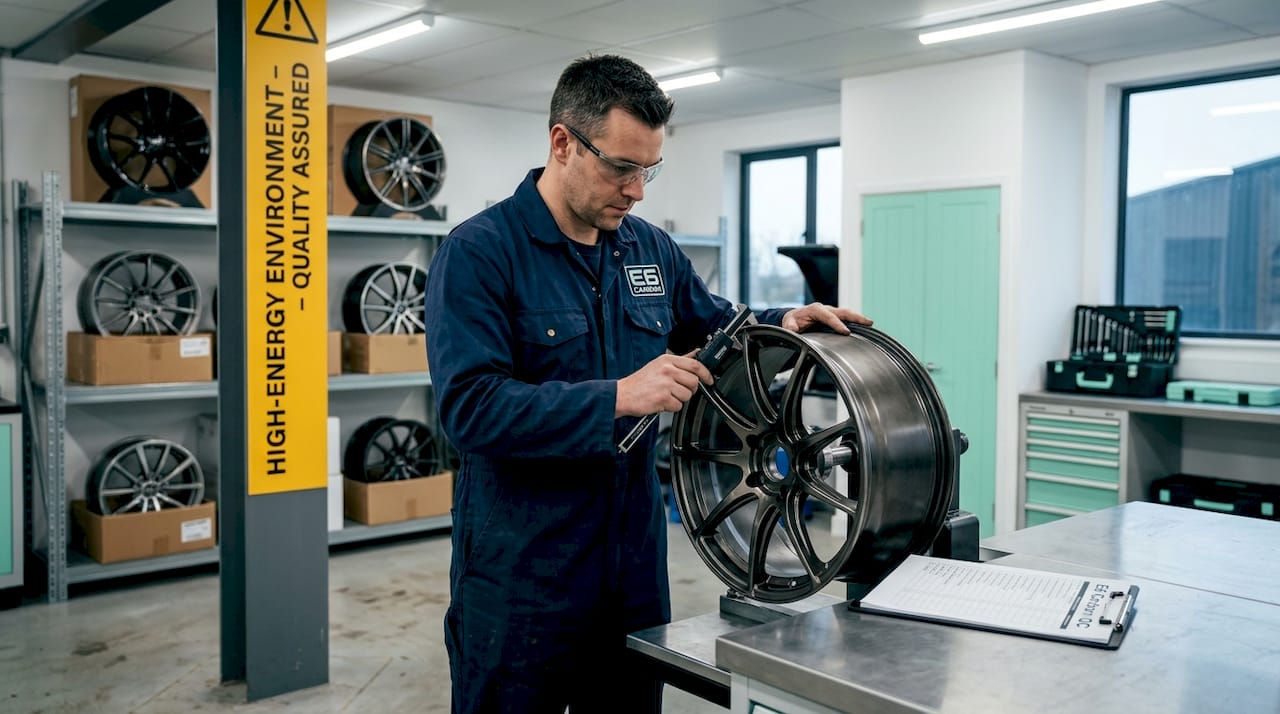
Quality control runs throughout. Dimensional checks happen after flow forming and again after heat treatment because the barrel can spring slightly during quenching. The tightest shops also perform X-ray or dye penetrant inspection on finished wheels to verify there are no subsurface voids carried over from the casting stage.
| Property | Flow formed | Spun | Cast | Forged |
|---|---|---|---|---|
| Weight | Light | Moderate | Heaviest | Lightest |
| Strength | High | Moderate | Lowest | Highest |
| Cost | Moderate | Low-moderate | Lowest | Highest |
| Design flexibility | High | Limited | Very high | Moderate |
| Typical use | Street/track | OEM, budget | Entry-level | Motorsport, premium |
When you select performance wheels for a track or spirited street build, that table tells you a lot. Flow forming hits a sweet spot that pure casting cannot reach and pure forging does not need to occupy on a budget.
Comparing flow formed wheels: Pros, cons, and use-cases
With the process and equipment covered, let’s see how flow formed wheels stack up against other options and when they truly shine.
Flow forming allows controlled thinning and stretching that creates strength and precision well beyond what standard spinning or casting achieves. The practical benefits translate directly to the vehicle.
Advantages you will notice immediately:
- Weight savings. A flow formed wheel in a popular 19×9.5 fitment typically weighs 10 to 15 percent less than a comparable cast design. Unsprung weight reduction of even two pounds per corner meaningfully improves steering response and suspension compliance.
- Impact resistance. Because the barrel grain runs in the load direction, flow formed wheels resist pothole impacts and curb strikes better than cast equivalents.
- Cost efficiency. You get most of the strength benefit of a forged wheel at a price that is often 30 to 50 percent lower.
- Fitment precision. CNC-finished barrels hit tight tolerance specs, which matters for high-speed balance and TPMS sensor fitment.
Limitations worth knowing:
- The center section is still cast, so it does not benefit from full grain alignment. This is why flow formed wheels are rarely found at top-tier motorsport events where full forged is mandated.
- Custom offset and width options are less flexible than monoblock forged, where the entire wheel starts as a single billet.
- Wall thickness has a minimum floor. Aggressive thinning below safe limits weakens rather than strengthens the barrel.
For carbon fiber wheel insights, the comparison gets even more interesting because carbon construction eliminates metal fatigue entirely. But the price delta is substantial, which is exactly where flow formed fills a real gap.
Who should run flow formed wheels?
- Track day enthusiasts who need strong, light wheels without a forged budget
- Street performance drivers on BMW M-series, Mercedes-AMG, or Nissan Z who want meaningful unsprung weight reduction
- Owners upgrading to racing wheels for the first time from stock cast fitments
- Show car builders who want a finished, premium look without the lead time of custom forged
Pro Tip: Pair flow formed wheels with quality wheel and tire maintenance practices to maximize their service life. Consistent torque checks after installation and regular inspections for microcracks near spoke roots will keep a set running reliably for years.
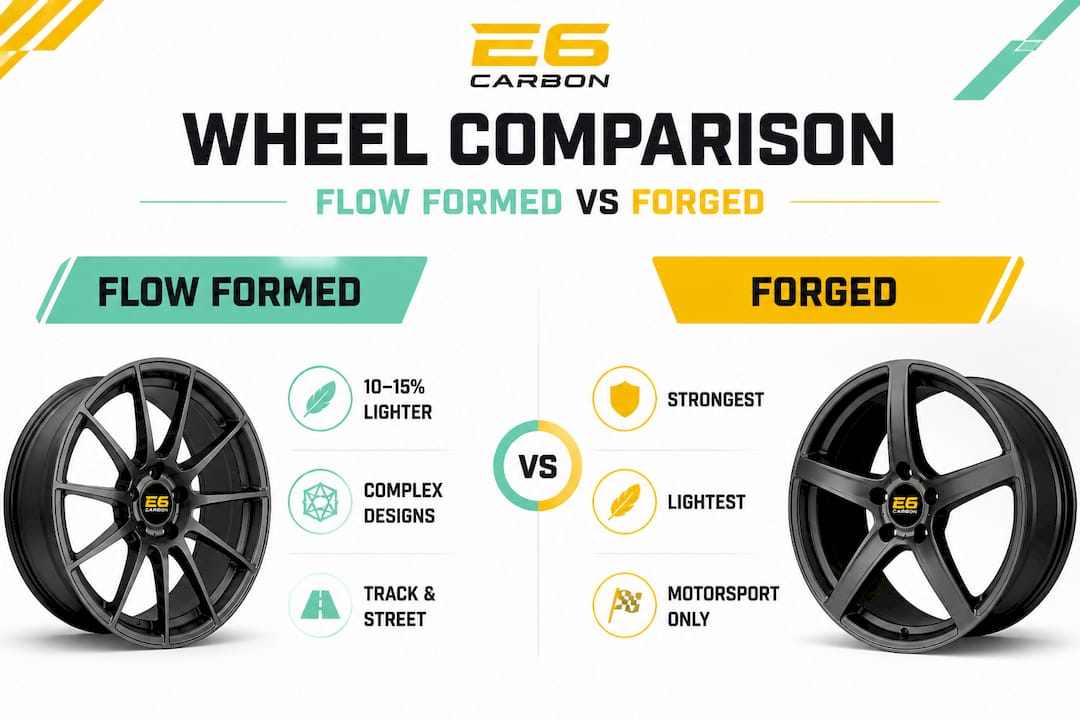
| Comparison point | Flow formed vs. cast | Flow formed vs. full forged |
|---|---|---|
| Weight savings | 10-15% lighter | 5-10% heavier |
| Strength | Significantly stronger | Slightly lower |
| Cost | 20-40% more | 30-50% less |
| Lead time | Short | Longer for custom |
| Repairability | Good | Excellent |
Application tips: How to choose and care for flow formed wheels
Having compared your wheel options, now it is time to get hands-on. Here is how to choose, fit, and maximize your flow formed wheels for your build.
Flow formed wheels offer precise material control that makes them well-suited for performance applications, but picking the right set requires more than matching bolt pattern and diameter.
Follow this process when specifying flow formed wheels:
- Define your primary use case. Track days, daily driving, autocross, and show car duty all pull in slightly different directions. Track use favors minimum weight and maximum structural rating. Daily driving adds road condition tolerance to the list.
- Set a realistic weight target. Calculate the rotational inertia improvement you are chasing. A common benchmark is targeting at least a 10 percent reduction versus your stock wheel weight per corner.
- Verify load rating. Every quality flow formed wheel carries a published load rating. Your vehicle’s GVWR divided by four gives you a minimum per-wheel figure. Add a 15 to 20 percent buffer for spirited driving.
- Check offset and clearance. Flow formed wheels are available across a wide offset range, but your brake caliper, fender lip, and suspension geometry all set hard limits. Use a wheel fitment calculator before ordering.
- Inspect the finish specification. Powder coat over a properly prepared aluminum surface will outlast paint-only finishes. Ask whether the barrel interior is coated, as exposed uncoated aluminum inside the barrel corrodes faster in regions that use road salt.
- Demand certifications. JWL and VIA certifications (Japanese standard) or TUV approval (European standard) confirm the wheel has passed independent structural testing. No certification is a red flag regardless of how good the marketing looks.
Inspection checklist before first fit:
- Check runout at the bead seat: lateral and radial deviation should be under 0.5mm
- Inspect spoke roots for any surface cracking from machining
- Verify center bore diameter matches your hub to avoid centering on lug nuts alone
- Confirm valve stem hole is drilled cleanly, with no burrs that could damage a TPMS sensor
Pro Tip: The most common mistake enthusiasts make when upgrading is sizing up in diameter without accounting for the reduction in sidewall height needed to keep overall diameter correct. Dropping sidewall height increases the wheel’s vulnerability to pothole damage and transmits more road noise into the cabin, partially canceling the refinement gains you bought the new wheels for.
The custom wheels buying process involves more variables than most buyers realize, and getting the spec sheet right before you commit to a set saves significant time and money.
What most enthusiasts miss about flow formed wheels
Here is where things get honest. Flow formed wheels occupy a genuinely misunderstood position in the market, and the misunderstanding runs in both directions. Budget buyers dismiss them as overpriced cast. Premium buyers dismiss them as not-quite-forged. Both groups are wrong, and both are missing performance value as a result.
The persistent belief that “forged is always better” ignores context almost entirely. A full forged wheel is stronger than a flow formed wheel of the same dimensions, yes. But stronger than what the application actually demands? On a 2,900 kg SUV doing track days? Possibly not. The engineering margin in a well-specified flow formed wheel often exceeds what street or even club motorsport actually puts into the metal. Paying for full forged in that scenario buys reassurance, not necessarily real-world performance delta.
What matters more than the manufacturing label is the quality of execution within that method. A poorly made full forged wheel from a discount supplier is genuinely less safe than a precisely flow formed wheel from a rigorous manufacturer. We see this firsthand when customers bring in competitor sets for comparison. The label says forged. The metallurgical reality says otherwise.
The other thing most buyers miss is that flow forming unlocks design complexity that pure forging struggles with. Because the center is cast before the barrel is worked, designers can achieve spoke geometry and surface relief that billet machining would either make impossible or cost-prohibitive. You can get a visually striking, aggressive design AND meaningful weight savings from a good flow formed set. That combination is genuinely rare in the wheel market.
Where flow forming earns legitimate criticism is in the category of ultra-high-stress motorsport. Endurance racing, hillclimb, and high-downforce circuit applications put wheel loads into territories where the cast center section becomes the limiting factor. That is the honest version of the conversation sales reps usually avoid. For those builds, the path leads to full forged monoblock or multi-piece, and looking at racing spec wheels purpose-built for that environment makes far more sense than pushing flow formed beyond its design intent.
Level up your build with advanced wheel solutions
Understanding flow forming gives you a sharper lens for every wheel decision you will make from here forward. That clarity is most valuable when you pair it with options that are actually engineered to the standard the technology promises.

At E6 Carbon and E6 Forged, we build across the full spectrum of high-performance wheel manufacturing. Whether you are looking at our AR03 multipiece wheels for a fitment that pushes design and strength simultaneously, or you want to start with our performance wheel upgrade guide to map your build correctly from the start, we have the technical depth to support every stage of your decision. Before you mount anything, our forged wheel safety guide is worth reading to make sure every set you run is genuinely safe under load.
Frequently asked questions
Is flow forming the same as forging?
No, flow forming and forging are distinct processes that produce different wheel characteristics. Flow forming uses rollers to thin and elongate the barrel, while forging uses extreme pressure to shape a solid billet, resulting in different grain structures and mechanical properties across the full wheel.
Are flow formed wheels stronger than cast wheels?
Yes, flow formed wheels are typically stronger and lighter than cast equivalents. Flow forming produces stronger, more precise barrel sections than standard casting by aligning the aluminum grain structure along the primary stress axis during production.
Can flow formed wheels be used on track and for daily driving?
Absolutely. Flow formed wheels balance strength, weight reduction, and cost in a way that suits both track day use and daily driving, making them one of the most versatile upgrade options available to performance enthusiasts.
What should I look for when shopping for flow formed wheels?
Prioritize certified brands with JWL, VIA, or TUV approval, confirm the published weight matches your fitment needs, and verify the barrel wall thickness specs are disclosed clearly. Transparency on manufacturing data separates serious manufacturers from marketing-first suppliers.
How do I maintain my flow formed wheels for long life?
Regular cleaning with pH-neutral wheel cleaners, periodic torque checks on lug nuts, and consistent visual inspection for cracking near spoke roots will maximize service life. Proper wheel and tire maintenance habits protect both the structural integrity and the finish of your investment.