TL;DR:
- Many wheels marketed as “forged” vary significantly in manufacturing quality, with float forged sitting as a practical mid-point. Float forged wheels improve barrel strength, reduce weight, and enhance handling more than cast wheels, providing excellent value for street and mild track use. However, full forged wheels remain the best choice for racing, emphasizing the importance of verifying manufacturing details before purchase.
The car wheel market is buried in buzzwords, and “forged” is one of the most abused. Walk into any wheel shop or browse any enthusiast forum and you’ll hear it thrown around like a guarantee of quality, strength, and performance. But here’s what most people don’t realize: not all forged wheels go through the same process, and “float forged” sits in its own distinct category that confuses even seasoned enthusiasts. Understanding exactly what that term means, and where it delivers real value, can be the difference between a smart investment and an expensive disappointment.
Table of Contents
- Breaking down wheel manufacturing: Cast, float forged, and true forged
- Why choose float forged? Real-world performance and value
- Float forged vs full forged vs cast: Which is right for you?
- What to watch for: Shopping tips and common mistakes
- A fresh perspective: Why ‘float forged’ is usually the enthusiast’s sweet spot
- Upgrade your performance with premium forged wheel solutions
- Frequently asked questions
Key Takeaways
| Point | Details |
|---|---|
| Float forged is a hybrid | Float forged wheels combine pressure-formed barrels with cast centers for a balance of weight, strength, and price. |
| Performance is real | Float forged wheels reduce unsprung mass, improving handling, ride quality, and responsiveness compared to cast wheels. |
| Know the process | Always verify what part of the wheel is float forged and buy from reputable vendors to avoid misleading claims. |
| Not all cars need full forged | For most street and mild track applications, float forged offers nearly all the functional benefits of full forged wheels at less cost. |
Breaking down wheel manufacturing: Cast, float forged, and true forged
Before you can evaluate what’s right for your build, you need a clear picture of how wheels are actually made. The three main manufacturing methods you’ll encounter are casting, flow/float forging, and true (full) forging. Each one affects the wheel’s structure, weight, and performance in very different ways.
Casting is the most common and most affordable method. Liquid aluminum is poured into a mold and allowed to cool. The resulting wheel is relatively heavy and can have internal air pockets, called porosity, that weaken the structure. Cast wheels work fine for most passenger cars but offer limited performance headroom for high-load or track applications.
True forged wheels are manufactured by compressing a solid aluminum billet under extreme pressure, then CNC-machining the final shape. This process aligns and densifies the grain structure, dramatically reducing porosity and producing a wheel that is both lighter and stronger than any cast alternative. These wheels carry a premium price because the process is labor-intensive and material waste is significant.
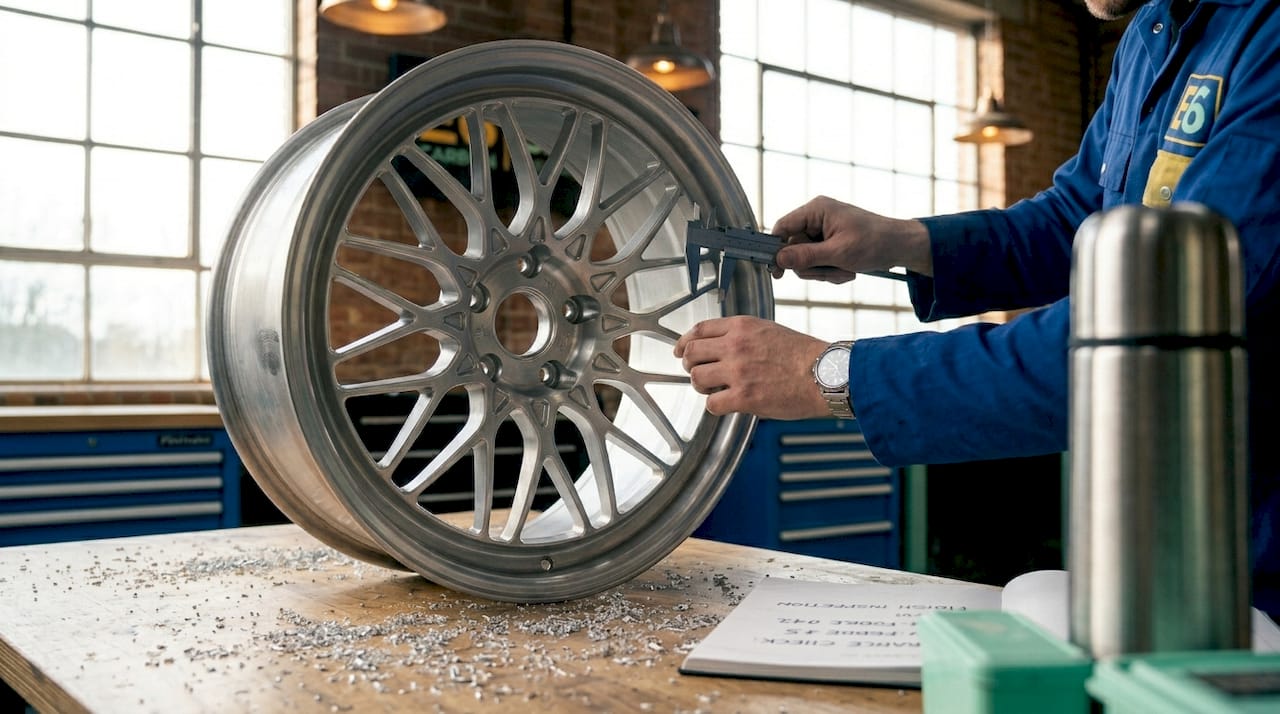
Float forged (also called flow forged or flow formed) sits between those two. The center and spokes of the wheel begin as a cast piece, but the barrel is then subjected to high-pressure rollers that stretch, compress, and work the metal. As the float forged process applies pressure specifically to the barrel, that section gains improved grain structure and reduced wall thickness, while the face remains cast. The result is a hybrid wheel that is meaningfully better than a pure cast unit but not equivalent to a fully forged one.
Quick comparison: How the three methods stack up
| Feature | Cast | Float forged | True forged |
|---|---|---|---|
| Manufacturing cost | Low | Mid | High |
| Weight | Heaviest | Moderate | Lightest |
| Barrel strength | Lower | Improved | Highest |
| Face/spoke strength | Moderate | Moderate | Highest |
| Porosity risk | Higher | Moderate | Lowest |
| Best use case | Daily driving | Street/mild track | Full track/race |
Key takeaways at a glance:
- Cast wheels are the starting point, not the benchmark for performance
- Float forged wheels improve barrel integrity without a full forging premium
- True forged wheels deliver maximum performance but at a significantly higher cost
- Flow formed wheel technology is constantly advancing, narrowing the gap with full forging in some applications
Understanding this foundation matters because marketing materials often blur these lines deliberately. A wheel marketed simply as “forged” could refer to any variation of the process, and only the technical details reveal what you’re actually getting.
Why choose float forged? Real-world performance and value
Now that you know the manufacturing basics, why does the float forged method actually matter on the road? The answer comes down to unsprung mass, rotational inertia, and material integrity. These aren’t abstract concepts. They translate directly into what you feel through the steering wheel and how your car handles at the limit.
Unsprung mass is any weight not supported by the suspension, including wheels, tires, and brake components. Every pound you remove from this category has a multiplied effect on handling compared to removing weight from the chassis. Lighter wheels mean the suspension can react faster to road imperfections, keeping the tire in contact with the pavement more consistently. This is measurable in lap times and obvious in everyday driving feel.
Rotational inertia works similarly. A heavier wheel takes more energy to spin up to speed and more energy to slow down. Lighter rotational mass from forged-family wheels directly improves throttle response, braking distances, and the overall feeling of agility. It’s one of those upgrades where the physics are undeniable.
Float forged wheels typically weigh 10 to 20 percent less than a comparable cast wheel in the same size. For a set of 20-inch wheels, that can represent a total weight savings of 8 to 16 pounds across all four corners, a noticeable improvement by any measure.
Expected performance outcomes by wheel type
| Improvement category | Cast | Float forged | True forged |
|---|---|---|---|
| Weight reduction vs. OEM | 0 to 5% | 10 to 20% | 20 to 30%+ |
| Barrel impact resistance | Baseline | Meaningfully improved | Best |
| Steering feel improvement | Minimal | Noticeable | Maximum |
| Ride quality sensitivity | Moderate | Good | Excellent |
Here’s how to think about the real-world value of float forged in a practical sequence:
- You reduce unsprung weight, which immediately improves how your suspension tracks the road
- Reduced rotational inertia makes your engine work less hard during acceleration and braking
- The improved barrel structure handles impacts from road debris and potholes better than cast alternatives
- Your tires perform more consistently because the wheel deforms less under cornering load
- Long-term durability improves because the barrel is less prone to micro-cracking under repeated stress
Pro Tip: When comparing float forged options, ask manufacturers for the actual wheel weight in your specific size and offset, not just a range. A spec sheet with real numbers separates credible manufacturers from marketing-first brands.
When it comes to durability, float forged barrels resist cracking from curb strikes and road impacts better than cast barrels of the same thickness. Because the pressure-forming process refines the grain structure of the barrel specifically, that section of the wheel behaves closer to a fully forged unit. The face and spokes still benefit from aluminum’s natural properties but don’t receive the same level of enhancement. For the racing wheels performance context, this distinction matters enormously when choosing between a wheel for occasional track days versus full competition use.
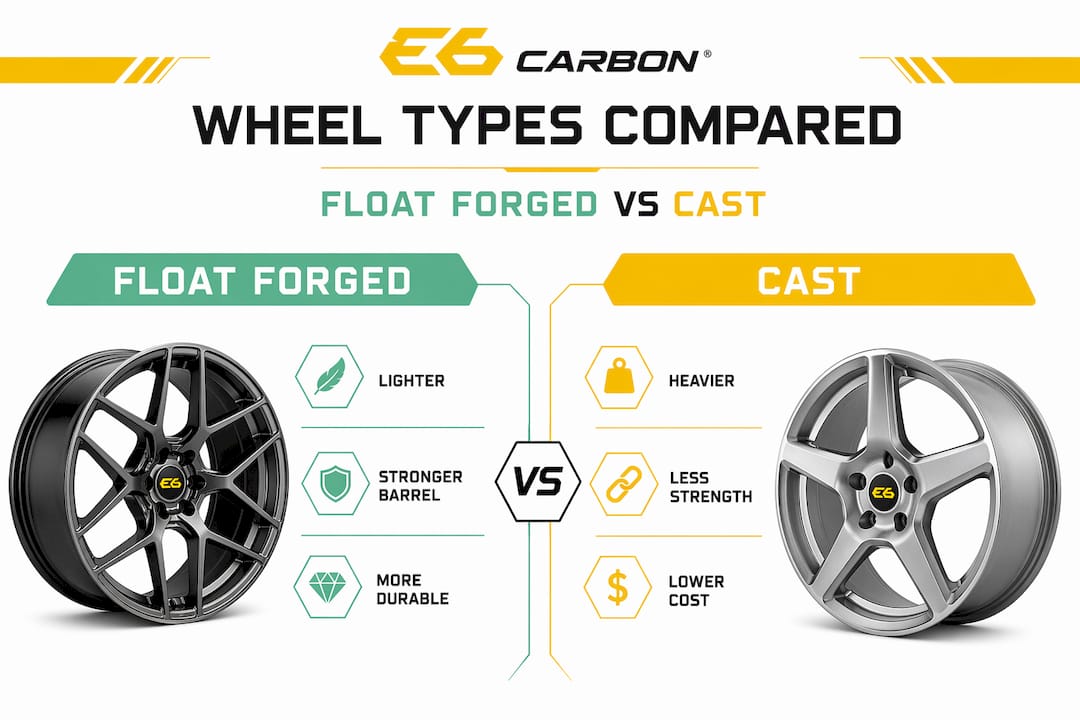
The connection between wheel choice and handling is direct and well-documented. Float forged wheels deliver enough of the structural benefits of full forging to make a meaningful difference on street-driven performance cars, which is exactly where the majority of enthusiasts operate.
Float forged vs full forged vs cast: Which is right for you?
With performance and value spelled out, how do you choose the best option for your needs? The honest answer depends on four variables: your budget, your vehicle type, how you drive it, and what you want from the upgrade.
Decision guide by use case
| Buyer profile | Recommended type | Reason |
|---|---|---|
| Daily driver, budget-conscious | Cast or float forged | Float forged adds durability without breaking the bank |
| Street performance/luxury car | Float forged | Best blend of weight, strength, and cost |
| Occasional track days | Float forged or true forged | Depends on severity of use and goals |
| Full racing/competition | True forged only | Maximum strength and minimum weight required |
| Show car/aesthetics-focused | Any, finish is the priority | Weight savings matter less; looks are everything |
Consider a real-world scenario. You own a BMW M4 that you drive hard on weekends and take to two or three track days a year. Full forged wheels are overkill for your situation and will cost you significantly more. A quality float forged set saves meaningful weight, handles the occasional track load without issue, and looks as good as anything else on the market. That’s the float forged value proposition at its clearest.
Now contrast that with a Lamborghini Huracán GT3 running a full racing program. That car operates at sustained high loads, experiences extreme brake heat cycling, and puts enormous lateral forces through the wheels. Here, full forged is the only defensible choice, and the price premium is justified by the demands.
“If your goal is premium looks plus noticeable weight reduction and better barrel durability at a mid-tier price, flow-forged/‘float forged’ style wheels can be the practical compromise — just confirm that the specific wheel you’re buying matches the claimed process/locations of strengthening.”
Pro Tip: When evaluating a float forged wheel for a high-performance car, always verify which sections of the wheel are actually pressure-formed. Some manufacturers claim the full float forged designation when only a minor portion of the barrel has been worked. Detailed spec documentation and verified manufacturing partners are your best protection.
Pay attention to how wheel design impacts both performance and aesthetics. The best wheel choice aligns structure with visual intent. For more guidance on fitment and selection, a detailed guide on matching wheels to your car will walk you through the specifics by vehicle type.
What to watch for: Shopping tips and common mistakes
You know what to look for. Now let’s make sure you don’t get tripped up when you go shopping. The wheel market has a marketing language problem, and “float forged” is one of the most stretched terms in the industry. Some brands apply it loosely to wheels where only minimal pressure work was done on the barrel. Others use it accurately to describe a rigorous, performance-validated process.
Here’s what to verify before you buy:
- Request a spec sheet that explicitly states which portions of the wheel are pressure-formed and which are cast
- Ask for documented weight specs in your exact size, not an approximation
- Check for third-party testing or certifications such as JWL (Japan Light Alloy Wheel standard) or TUV approval
- Verify the manufacturer’s facility or process through independent reviews, not just brand marketing
- Look for detailed barrel markings or documentation that confirms the pressure-forming process was applied
- Read enthusiast forums specific to your car to find real-world user experiences with the specific wheel brand
One of the most common mistakes buyers make is treating the term “float forged” as a universal standard when it describes an intermediate process that varies significantly in how well it’s executed. Two wheels with identical marketing language can have dramatically different real-world performance based on how thoroughly the barrel was worked and what alloy was used.
Misleading claims to watch for in advertisements include phrases like “fully engineered forging process” or “forged-grade strength” without specifics, vague references to “forged technology” without clarifying what part of the wheel was treated, and price points that seem too low for a genuine forging operation.
Pro Tip: For luxury and exotic vehicles specifically, always ask whether the wheel has been load-tested for your vehicle’s GAWR (Gross Axle Weight Rating) and whether the manufacturer offers any structural warranty. A brand that can’t answer that question clearly is not ready to equip your Ferrari or McLaren.
For guidance on evaluating and maintaining your investment, the performance wheel finish guide covers what to inspect and how to keep your wheels in top condition for the long term.
A fresh perspective: Why ‘float forged’ is usually the enthusiast’s sweet spot
Here’s a take that most wheel marketing won’t give you: full forged wheels are oversold for the majority of real-world applications. The performance gap between a quality float forged wheel and a true forged unit, on a street-driven sports car, is smaller than the price gap suggests. What you’re often paying for at the top tier is bragging rights as much as measurable performance.
This isn’t an argument against full forging. For genuine racing applications, it’s absolutely the right call. But for the driver who wants to transform how their BMW M3, Lexus LC500, or Mercedes-AMG GT feels and looks on the road, a well-made float forged wheel delivers 85 to 90 percent of the functional benefit at 50 to 65 percent of the full forged cost. That math is hard to ignore.
The savvier move isn’t always to buy the most expensive option available. It’s to understand your actual use case, verify what you’re buying with real documentation, and choose a manufacturer who can stand behind both the process and the product. The enthusiasts who get the most satisfaction from their wheel upgrades are the ones who matched the spec to the application rather than the spec to the marketing headline.
We’ve also seen a fascinating side effect of the float forged conversation: it pushes buyers to read more carefully, ask harder questions, and engage with the engineering behind their purchases. That shift in buyer behavior is good for the whole industry. It forces manufacturers to be more transparent and rewards brands that invest in genuine quality.
One area where buyers sometimes stumble is assuming that forging of any kind eliminates all other variables. It doesn’t. Weight, finish, spoke design, offset, and tire pairing all interact with manufacturing quality. For a complete picture of what’s possible in the performance wheel space, exploring carbon fiber wheel facts versus myths adds useful context, especially as alternative materials become more mainstream in the premium segment.
Upgrade your performance with premium forged wheel solutions
When you’re ready to move from research to real hardware, the right manufacturing partner makes all the difference.
At E6 Forged, our AR03 multi-piece wheels and AR01 multi-piece wheels represent what happens when genuine forging expertise meets bespoke design for luxury and sports cars. Every set is engineered to meet the precise demands of vehicles like the Ferrari 812, Lamborghini Urus, and McLaren 720S, where performance tolerances and aesthetic expectations leave no room for compromise. Whether you’re looking for race-ready weight reduction or a show-stopping finish, our catalog covers the full range of what a premium forged wheel should deliver. Before you finalize your decision, our step-by-step forged wheel safety inspection guide will ensure your investment stays in perfect condition from the first drive forward.
Frequently asked questions
What does ‘float forged’ actually mean?
‘Float forged’ refers to a wheel where the barrel is strengthened through pressure forming while the center and spokes remain cast, creating a hybrid manufacturing process between standard casting and true full forging.
Are float forged wheels as strong as full forged?
Float forged wheels are significantly stronger than cast wheels, especially in the barrel, but full forged wheels offer higher overall strength and lower porosity across the entire wheel structure.
Is the extra cost of float forged wheels worth it?
For most street-driven performance cars, yes. Float forged wheels offer a strong value compromise between cast affordability and full forged performance, delivering noticeable handling and weight improvements at a more accessible price.
Will float forged wheels fit my luxury or sports car?
Most premium float forged wheels are available in a wide range of sizes and offsets to suit vehicles like BMW, Mercedes-AMG, Lamborghini, and Ferrari, but always confirm exact fitment specs including PCD, offset, and center bore before ordering.