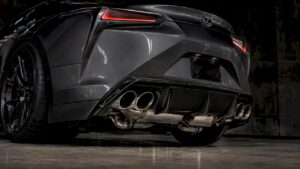
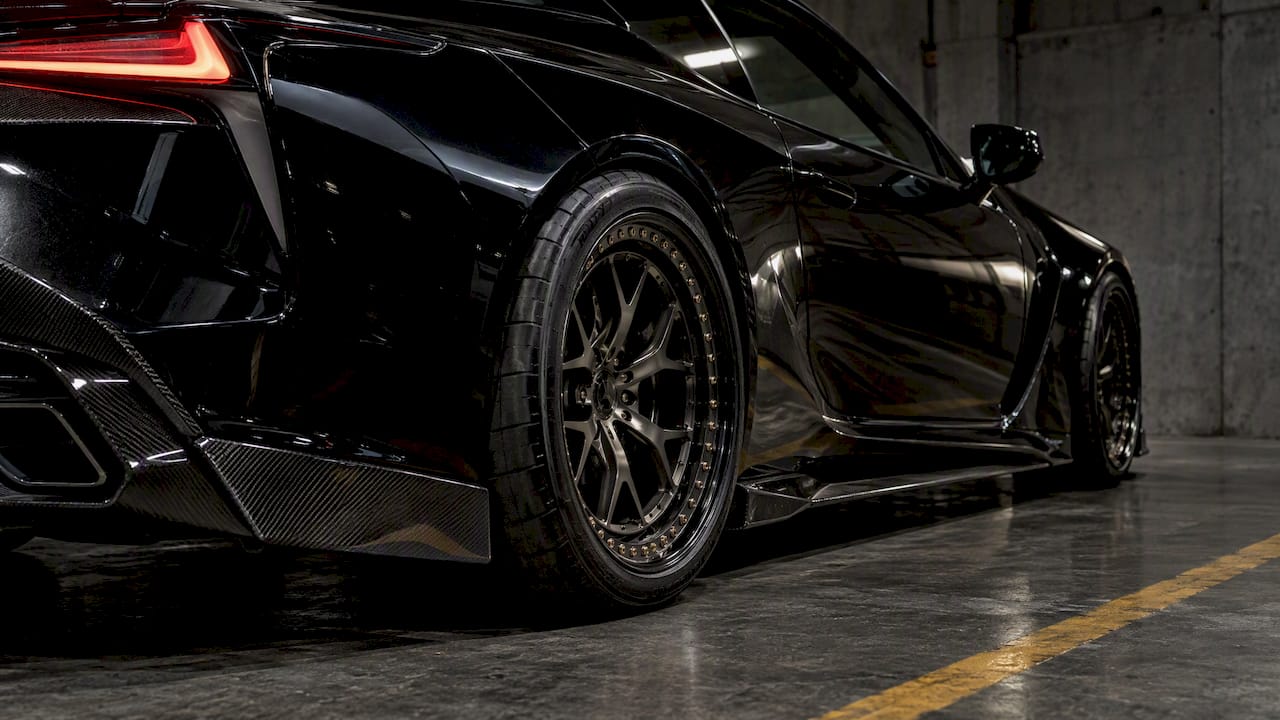
HR8X beadlock wheels from E6 Forged are offered in 18 to 21 inch diameters, 8.0 to 13.0 inch widths, and offsets from -40 to +60, forged from 6061-T6 aluminum and rated for applications up to 3500 whp. Before ordering any size, verify bead-seat diameter first: it governs airtight integrity and tire retention under load.
That single measurement decides whether a beadlock assembly holds the tire bead under heavy rotational torque or lets it slip on the rim under launch. Everything else, width, offset, backspacing, follows from getting that number right for your platform and tire combination.
TL;DR:
- Measure the bead seat diameter against the tire specification before choosing offset; the outer lip is not a reliable proxy for seating integrity under torque.
- For Mercedes AMG or Lexus LC500 brakes, 19 inch wheels, 9.0 to 10.5 inch widths, and +35 to +45 offsets are typical; verify trim year.
- Choose knurled bead seats for repeated high torque launches; standard seats suit street and light track use when tire pressure remains consistent.
- At 21 inches, request internal bell diameter at your chosen offset and check caliper and steering clearance at full lock, especially on exotic platforms.
Table of Contents
- HR8X key specifications and sizing matrix
- Fitment by diameter: 18-inch sizing and common applications
- Fitment by diameter: 19-inch sizing and common applications
- Fitment by diameter: 20-inch sizing and common applications
- Fitment by diameter: 21-inch sizing and common applications
- Installation, clearance, and internal architecture checklist
- Materials, performance rating, and engineering notes
- How HR8X beadlocks fit into a complete E6 performance system
- How to order E6 Forged HR8X beadlocks and complete your build
- FAQ
- Sources
HR8X key specifications and sizing matrix
HR8X beadlocks are built around a straightforward sizing logic: pick a diameter that matches your brake package and tire availability, then choose width and offset for the clearance envelope on your specific chassis. The matrix below outlines the core spec ranges across the diameter run.
Offset and backspacing describe the same relationship from different reference points. Offset measures the distance between the wheel’s centerline and its mounting face in millimeters, while backspacing measures from the mounting face to the inner lip in inches. A deeper positive offset pulls the wheel face inward, which can close the gap to a large front caliper, while a negative offset pushes the face outward for fitment over wide axles or widened fenders. On beadlock wheels specifically, the backspacing calculation also has to account for the retaining ring’s depth, which adds a few millimeters inward compared to a conventional lip.
Beadlock ring options and finishes shape both function and look:
- Standard bead seats suit street and moderate track use where tire pressure stays consistent.
- Knurled, anti-slip bead seats add mechanical grip against the tire bead for sustained high-torque launches, detailed further in our explainer on knurled bead seats.
- Carbon fiber centercap finishes are available across the HR8X line for weight savings and a motorsport-correct appearance.
- Ring bolt counts and spacing scale with diameter, since larger rings carry proportionally higher clamp loads, so it’s important to learn how to protect alloy wheels with ceramic coatings for maintaining their finish under stress.
The mechanics of how the bead seat itself locks the tire in place, independent of ring bolt torque, are covered in our guide to forged bead seating.
Fitment by diameter: 18-inch sizing and common applications
Eighteen-inch HR8X wheels are the most common choice for dedicated drag and street-strip builds where tire selection matters more than outright wheel diameter. An 8.0 to 9.0 inch width with a +30 to +40 offset suits most rear-drive drag applications running a narrower front and wider rear combination.
- Pair 8.0" to 8.5" fronts with a high-sidewall drag radial for predictable steering response.
- Pair 9.5" to 10.5" rears with a drag radial or slick sized for maximum contact patch under launch.
- Favor a taller sidewall on the rear for controlled tire growth and launch traction.
Before ordering, confirm brake caliper clearance against the wheel’s internal bell, hub bore diameter against your spindle, and overall tire diameter against fender and driveline clearance at full compression.
Pro Tip: Measure your caliper’s outer edge to hub centerline before selecting offset. A caliper that clears a cast wheel by a wide margin can still interfere with a beadlock ring’s added depth.

Fitment by diameter: 19-inch sizing and common applications
Nineteen-inch HR8X wheels are a frequent fitment point for Mercedes-AMG performance sedans and coupes, along with the Lexus LC500, where factory brake packages demand more internal clearance than an 18-inch wheel comfortably provides. A 9.5" to 10.5" width with offsets between +35 and +45 typically clears factory AMG big-brake kits while keeping the tire within the fender line.
On the Lexus LC500, a 9.0" to 10.0" width in a similar offset range accommodates the factory Brembo calipers without requiring a spacer, and the carbon centercap option complements the LC500’s standard carbon-trim aesthetic well.
- For street-driven Mercedes-AMG builds, a performance street tire in the 265 to 285 section width balances grip with ride comfort.
- For dedicated drag applications on either platform, a drag radial sized tighter to the rear fender maximizes sidewall flex.
- Confirm rotor diameter against the wheel’s internal bell before finalizing offset, since AMG and LC500 factory rotors vary across trim years.
Internal clearance checks matter more at 19 inches than at 18, since many of these platforms run larger factory rotors from the factory floor, not as an aftermarket addition.
Fitment by diameter: 20-inch sizing and common applications
Twenty-inch HR8X wheels suit mixed street and track builds where a larger contact patch and improved cornering stability matter alongside straight-line performance. A 10.0" to 10.5" width with offsets from +30 to +45 covers most combined-use applications on mid-size performance platforms.
- Widths above 11.0" at 20 inches work best on vehicles with wider factory fender flares or minor rolling.
- Rotor and caliper clearance tightens meaningfully at this diameter, since bigger brake kits are common upgrades paired with 20 inch wheels.
- A lower-profile tire improves steering feedback but raises unsprung weight sensitivity, so the wheel’s own weight becomes a larger factor in ride quality.
Because a 20 inch beadlock wheel carries more rotating mass than an 18 or 19 inch equivalent, the forged, machined construction of the HR8X line keeps weight gain modest relative to a cast wheel of the same size, a point we expand on in the materials section below.
Fitment by diameter: 21-inch sizing and common applications

Twenty-one-inch HR8X wheels address exotic platform fitments, including early McLaren and Lamborghini expansion builds, where factory wheel diameters already start at 20 or 21 inches and large-diameter carbon-ceramic brakes are standard equipment. Starting points here run 11.0" to 12.5" in width with offsets between +40 and +55, though exact figures depend heavily on the specific knuckle and caliper geometry of the platform.
At this diameter, internal bell narrowing becomes the primary fitment risk rather than an afterthought. As backspacing increases past roughly 4 inches, the wheel’s internal diameter can narrow enough to place a large-diameter caliper partially inside the restricted zone, a pattern documented across E6’s other beadlock fitment guides.
- Request internal bell diameter figures for your specific offset before ordering, not just the nominal width and offset numbers.
- Cross-check knuckle steering lock clearance at full lock, not just static clearance, especially on McLaren and Lamborghini platforms with aggressive steering geometry.
- Confirm lug pattern and hub bore against the exact trim year, since exotic platforms frequently revise these specs across model years.
Pro Tip: On low-clearance exotic builds, request a cardboard or 3D-printed clearance template from your installer before the wheels ship, since a half-inch of unaccounted backspacing can mean the difference between clean clearance and a caliper strike.
Installation, clearance, and internal architecture checklist
A disciplined measurement sequence prevents the two most common beadlock fitment failures: debeading under load and caliper interference after mounting. Follow this order rather than jumping straight to offset selection.
- Measure bead-seat diameter first and cross-check it against your intended tire’s bead specification. Bead-seat diameter, not the outer wheel lip, is the measurement that governs seating integrity, and relying on lip measurements as a proxy is a common source of seating failures under torque.
- Verify internal bell dimensions against caliper and steering clearance. Beadlock wheels with internal architecture can narrow past 4 inches of backspacing, so request the internal diameter figure at your chosen offset rather than assuming it scales linearly with nominal width.
- Convert offset to backspacing, confirm hub bore and lug pattern, and torque the beadlock ring bolts to specification in the sequential pattern recommended for your ring size, checking torque again after the first heat cycle since new bead seating can settle slightly.
SAE J2530 defines the performance requirements and test procedures used for evaluating aftermarket passenger and light-truck wheels, giving professional installers a standards-based reference point when evaluating wheel strength claims.
Skipping the sequence, especially jumping straight to backspacing without confirming bead-seat diameter, is the most common cause of post-install returns on beadlock assemblies across the industry.
Materials, performance rating, and engineering notes
HR8X beadlocks are forged from aerospace-grade 6061-T6 aluminum, an alloy chosen for its strength-to-weight ratio and its reliable fatigue behavior under repeated load cycles rather than for raw peak strength alone. Forging aligns the metal’s grain structure under compression, which produces a denser, more fatigue-resistant part than a cast wheel of the same alloy, and precision machining after forging removes excess material without compromising the forged grain flow near load-bearing sections.
- Forged construction supports an application rating of up to 3500 whp, a figure we state as our own engineering claim for the HR8X line rather than an independently verified industry benchmark.
- Precision machining after forging reduces unsprung weight compared to cast alternatives of equivalent strength, which improves suspension response and reduces rotational inertia at the contact patch.
- Lower unsprung weight also reduces strain on wheel bearings and suspension bushings over repeated high-load cycles.
SAE J2530 remains the current recommended practice for aftermarket wheel performance testing, giving shops and engineers a consistent framework for evaluating strength claims across manufacturers. Referencing that standard alongside a manufacturer’s own rated application figures gives a fuller picture than either number alone. HR8X wheels are purpose-built for high-torque launch applications, where the combination of forged strength and beadlock retention addresses the specific failure mode of bead slippage under sudden torque application.
How HR8X beadlocks fit into a complete E6 performance system
A correctly sized HR8X beadlock wheel is only one half of a coordinated launch and aero package. Pairing it with autoclave-cured 2×2 twill dry carbon components, such as the E6 Carbon Elite Kit for the Lexus LC500, reduces front and rear aerodynamic mass without adding the resin weight that a wet-layup panel carries, which matters at both drag strip launch and high-speed stability on track.
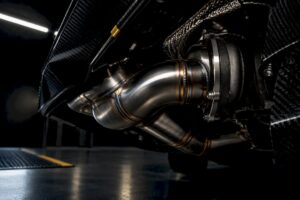
On the drivetrain side, high-flow performance downpipes from E6 Motorsports change the torque delivery curve feeding the wheel and tire, which is exactly the load condition HR8X beadlock rings are engineered to resist. A wheel sized correctly for bead-seat integrity but paired with a drivetrain producing sharper torque spikes still benefits from the knurled bead-seat option discussed earlier.
Because fitment interacts across all three systems, wheel offset, aero clearance, and drivetrain torque characteristics, we recommend consulting our engineering team on bespoke builds rather than ordering diameter and offset in isolation, particularly on exotic platforms where small deviations compound quickly.
— E6 Engineering
How to order E6 Forged HR8X beadlocks and complete your build
We build every HR8X set to your vehicle’s actual clearance envelope rather than a generic diameter chart, which is why we ask for a short set of measurements before confirming width and offset. Start with your VIN, current brake rotor and caliper dimensions, tire size goals, and intended use case, drag, street, or combined.
- Gather VIN, factory or aftermarket brake measurements, and desired tire size before requesting a quote.
- Specify use case (drag launch, street, track day, or mixed) so offset and bead-seat type match your actual load conditions.
- Ask about custom widths and offsets outside the standard matrix if your platform needs a figure between listed increments.
- Choose the knurled anti-slip bead seat for repeated high-torque launches, or the standard seat for street and light track use.
- Select a carbon fiber centercap finish and confirm whether you want our professional in-house installation service handling the mount and ring torque sequence.
Browse the full build options on our E6 Forged wheels collection, or go directly to the E6 Forged Beadlock wheels page to start a configuration with your vehicle’s measurements on hand.
FAQ
What diameters are available for E6 Forged HR8X beadlock wheels?
HR8X beadlocks are offered in 18, 19, 20, and 21 inch diameters, with widths ranging from 8.0 to 13.0 inches depending on diameter. Offsets run from -40 to +60 across the line, with exact availability varying by size.
What horsepower rating do HR8X beadlocks support?
HR8X wheels are rated by our engineering team for applications up to 3500 whp, based on the forged 6061-T6 construction and beadlock ring design. This figure reflects our own stated engineering rating for the HR8X line rather than an independent third-party certification.
Why does bead-seat diameter matter more than outer wheel diameter?
Bead-seat diameter is the specific surface that holds the tire bead in place under torque, and it governs seating integrity far more directly than the wheel’s outer lip measurement. Using lip diameter as a stand-in for bead-seat diameter is a common cause of improper seating and bead slippage.
Do HR8X beadlocks fit Mercedes-AMG and Lexus LC500 brake packages?
Yes, 19 inch HR8X configurations in the 9.0" to 10.5" width range with offsets between +35 and +45 are common starting points for factory AMG and LC500 brake packages. Exact clearance still depends on your specific trim year and any aftermarket brake upgrades, so confirming rotor and caliper dimensions before ordering is recommended.
What is the difference between a knurled and standard bead seat?
A knurled bead seat adds a textured, anti-slip surface that grips the tire bead mechanically during hard launches, while a standard bead seat relies on clamping force alone. Knurled seats are typically chosen for dedicated drag and high-torque applications rather than street-only use.
Sources
- J2530_202412: Aftermarket Wheels – Passenger Cars and Light Truck – Performance Requirements and Test Procedures
- Beadlock wheels explained — SoCal Prerunner
Recommended
- Fitment First E6 Two Piece Forged Wheels With Carbon Aero for LC500
- Fit 21–26in E6 HX5 Wheels Without Caliper Rub on AMG, LC500, Exotics
- Fitment First: E6 Forged 6061 T6 Wheels for C192 AMG GT63 5×112
- Knurled Bead Seats: Stop Tire Slippage in Performance Builds
Pricing, custom fitment options, and surface finishes subject to availability. Please contact E6 Carbon or E6 Forged directly to confirm vehicle-specific offset parameters, brake clearances, and current lead times prior to placing your order.