TL;DR:
- Raw forgings have rough surfaces, dimensional inconsistencies, and oxide scale that need secondary CNC machining for performance. CNC finishing refines surface roughness to Ra 0.8–1.6 micrometers and achieves precise tolerances, essential for high-load, luxury, and racing applications. Integrating forging with CNC machining preserves strength while delivering superior aesthetics and geometric accuracy critical for elite automotive components.
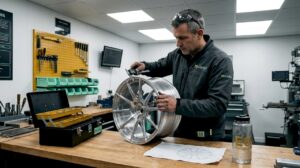
A freshly forged wheel blank is not race-ready. Even after the die opens and the aluminum or titanium alloy cools into its near-net shape, the part carries rough surfaces, dimensional inconsistencies, and oxide scale that would make any serious tuner wince. What transforms that raw forging into a component worthy of a Ferrari, Lamborghini, or McLaren is precision CNC machining, a secondary process that most enthusiasts underestimate or overlook entirely. This article breaks down the technical relationship between forging and CNC finishing, step by step, so you understand exactly what separates a mediocre wheel from a truly elite one.
Table of Contents
- From forging to finish: Why surface quality matters
- How CNC machining and forging integrate: Step-by-step workflow
- Precision machining: Delivering tolerances and aesthetics for luxury cars
- Forging vs CNC machining: Why integration matters most
- The tuning truth: What most enthusiasts miss about forged and CNC parts
- Unlock peak performance with advanced forged and CNC parts
- Frequently asked questions
Key Takeaways
| Point | Details |
|---|---|
| Forged parts need finishing | Forging creates strong shapes but only CNC machining achieves the surface quality needed for luxury vehicles. |
| Integration is best | Combining forging with CNC machining delivers unmatched strength, precision, and aesthetics. |
| Performance demands precision | High-performance components require tolerances and finishes only possible with advanced CNC processes after forging. |
| CNC doesn’t replace forging | While CNC machining is precise, it cannot provide the material strength benefits of a forged component. |
| Expertise ensures quality | Proper process integration preserves both the strength and the appearance that matter for elite automotive parts. |
From forging to finish: Why surface quality matters
Forging is celebrated for good reason. The process compresses metal under extreme pressure, aligning the grain structure and producing a part with exceptional strength-to-weight characteristics. But raw forgings are inherently rough. The die lubricants, the heat, and the compressive forces all leave their mark on the surface in ways that are unacceptable for performance applications.
A typical forged blank comes out of the die with surface issues that include:
- Pitting and scale from oxidation during high-temperature forging
- Parting line flash where excess metal squeezes between die halves
- Surface roughness measuring Ra 12 to 25 µm (micrometers), which is more than fifteen times too coarse for precision mating surfaces
- Dimensional variation across the blank due to die wear and thermal expansion during the forging cycle
- Tool marks and surface irregularities that would compromise both sealing interfaces and aesthetic appearance
These are not minor flaws. For a wheel hub bore, a caliper mounting face, or a bead seat, even a few microns of surface deviation can cause vibration, uneven clamping loads, or premature fatigue cracking under the dynamic loads of track driving.
“CNC machining is also used to achieve fine surface finish on forged blanks, enabling tribology-sensitive and aesthetic requirements that forged surfaces alone often cannot deliver without secondary machining.” This is the critical handoff point in premium part manufacturing.
CNC machining brings those rough forged surfaces down to Ra 0.8 to 1.6 µm, which is the accepted standard for performance wheel finishes that operate under continuous high-load cycling. The jump from Ra 25 µm to Ra 0.8 µm is not a cosmetic upgrade. It is the difference between a part that survives a track day and one that doesn’t. Understanding CNC machining for wheels reveals just how much engineering goes into what most people assume is a simple finishing step.
How CNC machining and forging integrate: Step-by-step workflow
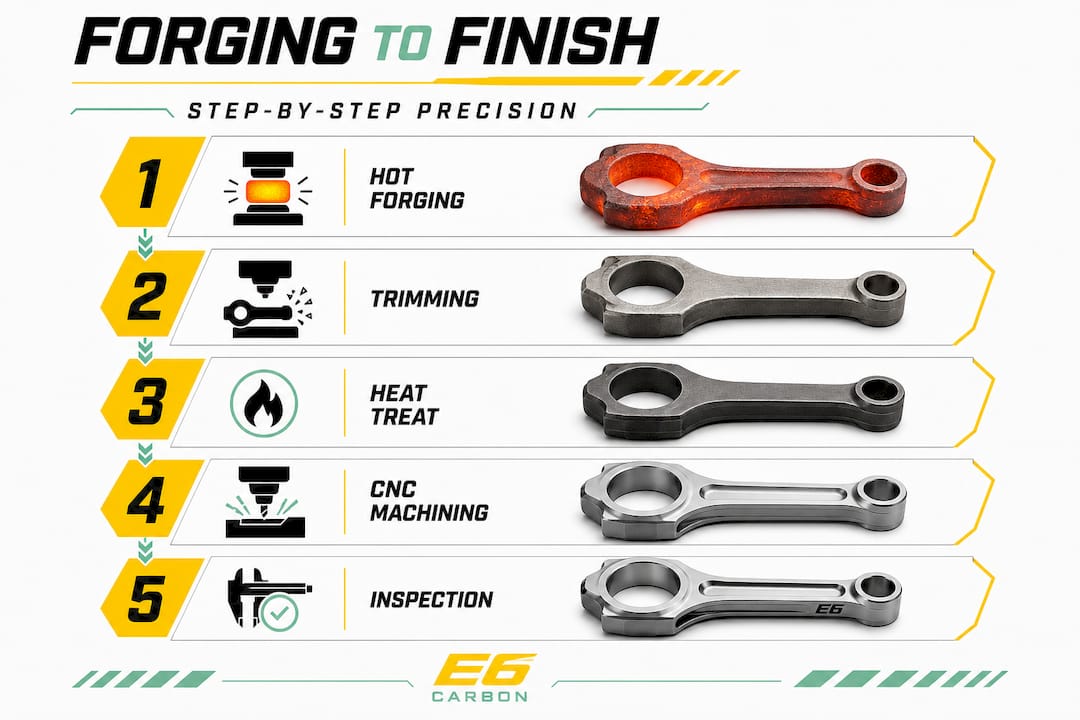
The transition from a forging press to a CNC machining center is not a casual handoff. It follows a deliberate sequence where every step preserves the structural benefits of forging while progressively adding the dimensional precision that luxury and performance applications demand.
Here is how the integrated workflow unfolds in practice:
Initial forging. The aluminum alloy (typically 6061-T6 or 7075-T6 for wheels) is pressed under 5,000 to 15,000 tons of force into a near-net shape. Grain flow follows the part geometry, dramatically improving fatigue resistance compared to billet-machined or cast parts.
Stress relief heat treatment. The forging is thermally cycled to relieve residual internal stresses introduced by the compressive forming process. Skipping this step allows hidden stress gradients to warp the part during CNC machining, throwing off final dimensions.
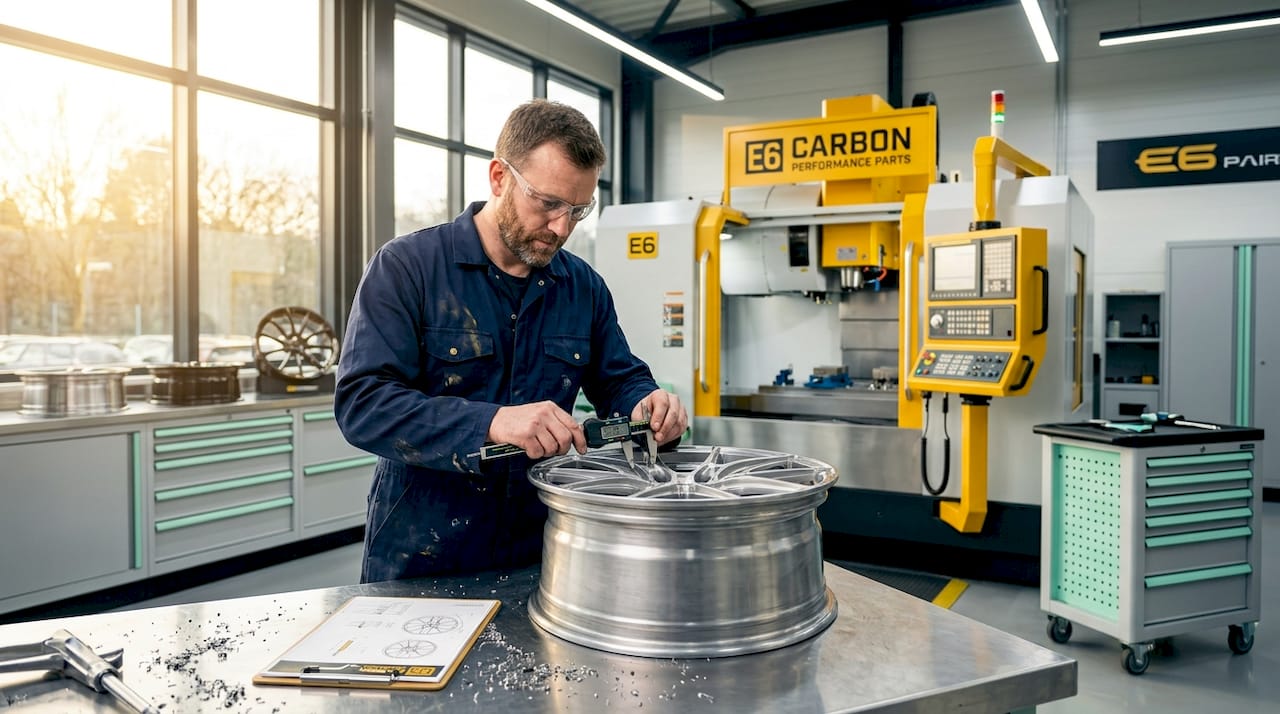
Rough CNC machining. The part is fixtured and the CNC removes large amounts of material to establish reference datums, faces, and bore features. At this stage, tolerances are held to roughly ±0.1 mm, removing scale and parting flash while setting up the geometry for finish passes.
Semi-finish machining. Finer toolpaths refine the geometry. Wall thicknesses are brought close to final specification. Spoke profiles on wheels begin to take shape. Tolerances tighten to ±0.05 mm.
Finish machining. High-speed spindles running at 15,000 to 20,000 RPM with fine carbide or diamond-coated tooling bring the surfaces to their final Ra values. Critical bore dimensions, bolt circle geometry, and hub centering are held to tolerances under 10 microns.
Final surface treatment. Anodizing, polishing, or custom coating is applied to the now-precise surface. Because the CNC-finished substrate is dimensionally accurate and smooth, coatings bond evenly and last significantly longer.
| Attribute | Forging only | Forging plus CNC |
|---|---|---|
| Dimensional tolerance | ±0.5 to ±1.0 mm | ±0.005 to ±0.01 mm |
| Surface roughness | Ra 12 to 25 µm | Ra 0.8 to 1.6 µm |
| Internal grain strength | Excellent | Excellent (preserved) |
| Geometric consistency | Moderate | High |
| Aesthetic readiness | Poor | Premium |
| Fit for high-load applications | No | Yes |
The CNC benefits for wheels at each stage compound. It is not just about one pass with a cutting tool. It is a staged refinement process that respects what forging created while correcting what forging cannot achieve on its own.
Pro Tip: When selecting forged wheels or suspension components, ask the manufacturer what CNC toolpath strategy they use for finish passes. A five-axis CNC approach on critical geometries preserves more material integrity than multiple repositioning passes on a three-axis machine, and it directly affects benefits of racing wheels like weight balance and fatigue life.
Precision machining: Delivering tolerances and aesthetics for luxury cars
Luxury performance vehicles operate in a different dimension of engineering expectation. A standard road car might tolerate a hub bore concentric to within 0.05 mm. A Ferrari 488 Pista or a McLaren 720S running track tires at high speed cannot. At those speeds and loads, even marginal geometric error introduces vibration harmonics that cascade through the chassis, steering, and driver feedback.
CNC machining after forging is what makes these tolerances achievable at production scale. Specific luxury and performance components that demand this level of precision include:
- Forged wheels (bolt circle accuracy, hub bore centricity, bead seat roundness)
- Wheel hubs and carriers (bearing seat geometry and face runout)
- Suspension knuckles (ball joint bores, tie rod mounts, and camber surfaces)
- Control arms (bushing bores and pivot alignment datums)
- Brake caliper mounting brackets (face flatness and thread engagement depth)
The data speaks directly to the performance gap between processes:
| Process | Typical surface roughness | Dimensional tolerance | Strength retention |
|---|---|---|---|
| Forging only | Ra 12 to 25 µm | ±0.5 to ±1.0 mm | 100% (baseline) |
| CNC machining only (from billet) | Ra 0.8 to 1.6 µm | ±0.005 to ±0.01 mm | 70 to 85% (no grain flow) |
| Forging plus CNC | Ra 0.8 to 1.6 µm | ±0.005 to ±0.01 mm | 100% (preserved) |
The statistic that surprises most tuners: CNC-refined surfaces can be more than ten times smoother than a raw forging, moving from Ra 25 µm to Ra 0.8 µm in a structured finishing sequence. That is not marketing language. It is a measurable, quantifiable output that directly affects how a tire seats, how a bearing loads, and how a wheel looks under the lights at a show.
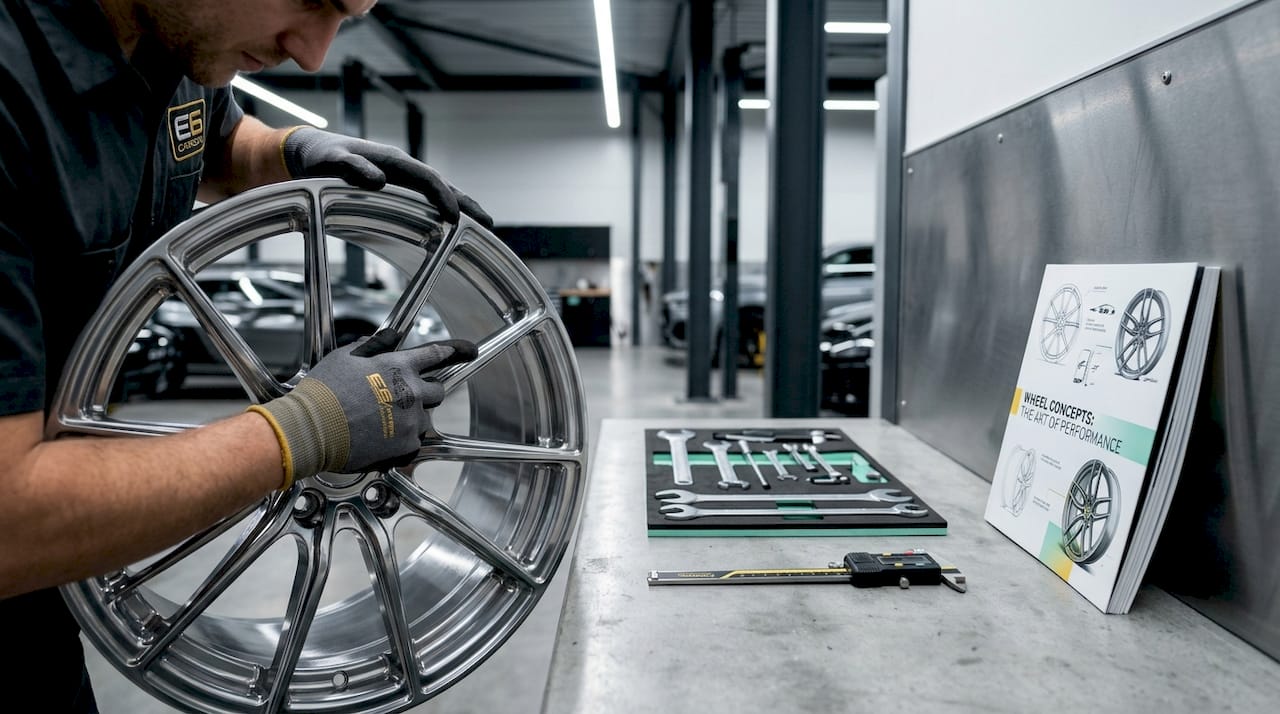
Aesthetics matter too, and not just for vanity. A mirror-polished spoke surface on a luxury wheel finish is CNC’s work. Custom face milling patterns, relief cuts, and precision chamfers that define the visual identity of a high-end wheel are impossible without CNC toolpaths operating at micron-level accuracy. These aesthetic choices also serve a structural purpose. Carefully machined relief geometry redistributes stress away from high-load transition zones. Reviewing specific wheel finish requirements reveals how tightly beauty and engineering overlap in this segment. For practical application, the installing forged wheels process also demonstrates why hub bore accuracy matters from the very first torque pass.
Forging vs CNC machining: Why integration matters most
There is a persistent debate in automotive forums that frames forging and CNC machining as competing technologies. This framing is wrong, and it leads buyers to make uninformed decisions. The two processes have fundamentally different capabilities, and neither one replaces the other.
What forging does exceptionally well:
- Aligns the metal’s grain structure along stress paths, maximizing fatigue resistance
- Achieves near-net shapes that minimize material waste
- Creates a work-hardened, dense microstructure that no cutting process can replicate
- Delivers the highest strength-to-weight ratio available in aluminum alloy components
What CNC machining does exceptionally well:
- Produces exact geometric dimensions with sub-10-micron repeatability
- Generates smooth surface finishes required for sealing, bearing fit, and aesthetics
- Enables complex three-dimensional features, pockets, and patterns impossible in a die
- Ensures batch-to-batch consistency across hundreds of identical parts
What each process cannot do alone:
- Forging cannot achieve the dimensional precision luxury vehicles require at any volume
- CNC machining from billet cannot replicate the grain flow and internal strength that forging creates in the metal
“CNC excels at precision geometry, but it does not replace the material-mechanics benefit of forging; the best outcomes for luxury and performance parts come from integrating forging (microstructure alignment and strength) plus CNC finishing (tolerances and surface integrity).” This is the manufacturing truth that premium brands operate from.
Pro Tip: When you evaluate a wheel manufacturer, ask specifically whether their product is forged then CNC machined, or CNC machined from billet only. A billet CNC wheel looks similar but carries none of the grain flow benefits. Understanding flow formed wheel technology is another dimension worth exploring, since flow forming adds a secondary forming benefit to cast blanks that partially mimics forging’s grain alignment.
The integration of both processes is not a compromise. It is the engineered optimum.
The tuning truth: What most enthusiasts miss about forged and CNC parts
Here is the uncomfortable reality: the “forged vs CNC” debate that drives so many forum threads is almost entirely beside the point. The brands marketing “fully CNC machined” parts without forging are selling you on a process that creates pretty geometry but misses internal strength. The brands screaming “forged!” without explaining their CNC finishing process are selling you on a starting point without telling you whether it was properly finished.
What we have seen repeatedly in premium manufacturing is this: the quality gap in forged wheel production is rarely in the forging press. It is in the CNC program, the fixturing approach, the toolpath strategy, and the metrology that confirms what was actually produced. An inferior CNC finish on a well-forged blank still produces a part that vibrates, corrodes unevenly, or fails to center correctly on the hub. The forging was great. The finish let it down.
The buyers who consistently make smart performance wheel upgrade strategy decisions are not the ones who memorize buzz terms. They are the ones who ask for manufacturing specifications. They want to know the forging alloy, the T6 heat treatment cycle, the CNC surface finish Ra value, the bolt circle tolerance, and the hub bore runout spec. When a manufacturer cannot or will not answer those questions, that is your answer.
The tangible payoff for informed buyers is real. Properly forged and CNC-finished wheels contribute measurably to lap time consistency, brake feel accuracy, and long-term structural reliability. They also hold their finish under track conditions far better than alternatives. This is not premium pricing for the sake of exclusivity. It is engineering precision that justifies every dollar.
Unlock peak performance with advanced forged and CNC parts
Understanding the manufacturing depth behind truly elite forged and CNC-finished components changes how you shop, specify, and upgrade your vehicle. Whether you are building a track-focused BMW M4, a show-quality Lamborghini Huracán, or a street-strip McLaren, the wheel and component specification decision is one of the highest-leverage choices you make.

At E6 Forged, every wheel starts with a precision forging and is brought to final specification through rigorous CNC machining sequences. The AR03 multipiece forged wheels and JF10 multipiece wheels exemplify this approach, delivering the grain-flow strength of aerospace-grade forgings with surface finishes and tolerances that satisfy the most demanding luxury and motorsport applications. Before installing, the forged wheel inspection guide gives you a practical framework for verifying the quality of any forged component before it goes on your vehicle.
Frequently asked questions
Why isn’t forging alone enough for performance car parts?
Forging creates strong shapes but leaves surfaces too rough and imprecise for high-performance needs, so CNC machining is essential for the final fit, tolerance, and finish that luxury and racing applications require.
Can a CNC-machined part be stronger than a forged part?
No; CNC creates precise geometry, but true strength comes from forging’s grain alignment, and CNC cannot replicate the internal material-mechanics benefits that the compressive forging process creates.
What automotive parts benefit most from CNC finishing after forging?
Wheels, hubs, suspension arms, steering knuckles, and caliper brackets all require CNC finishing because smooth precision surfaces in the Ra 0.8 to 1.6 µm range are essential for exact fit, load distribution, and long-term performance.
Is CNC machining required for all forged parts?
Not universally, but most high-performance or luxury-grade forged surfaces require secondary CNC finishing to meet the tight tolerances and premium aesthetic standards that demanding applications specify.
Does CNC machining damage the strength benefits of forged components?
Proper CNC technique fully preserves forging’s strength advantages, but poor toolpath selection or incorrect cutting parameters can introduce surface stress concentrations, which is why choosing correct CNC parameters and experienced manufacturing teams matter so much.